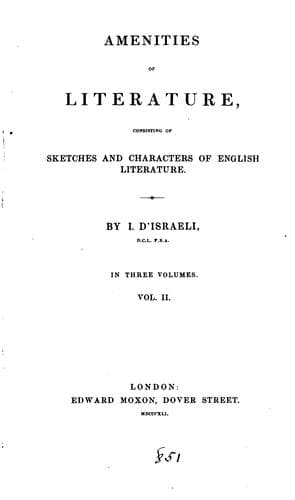
Amenities of Literature: Consisting of Sketches and Characters of English LiteratureDisraeli, Isaac
History
Amenities of Literature: Consisting of Sketches and Characters of English Literature
Disraeli, Isaac
Authors, English -- Biography; English literature -- History and criticism; Great Britain -- Intellectual life
At a period when Europe could hardly boast of three leisurely wayfarers
stealing over the face of the universe; when the Orient still remained
but a Land of Faery, and "the map of the world" was yet unfinished; at a
time when it required a whole life to traverse a space which three years
might now terminate, Sir JOHN MANDEVILLE set forth to enter unheard-of
regions. Returning home, after an absence of more than thirty years, he
discovered a "mervayle" strange as those which he loved to record--that
he was utterly forgotten by his friends!
He had returned "maugre himself," for four-and-thirty years had not
satiated his curiosity; his noble career had submitted to ordinary
infirmities--to gout and the aching of his limbs; these, he lamentably
tells, had "defined the end of my labour against my will, God knoweth!"
The knight in this pilgrimage of life seems to have contracted a duty
with God, that while he had breath he should peregrinate, and, having
nothing to do at home, be honourable in his generation by his enterprise
over the whole earth. And earnestly he prays "to all the _readers_ and
_hearers_ of my book," (for "hearers" were then more numerous than
"readers,") "to say for him a _Pater-Noster_ with an _Ave-Maria_." He
wrote for "solace in his wretched rest;" but the old passion, the
devotion of his soul, finally triumphed over all arthritic pangs. The
globe evidently was his true home; and thus Liege, and not London,
received the bones of an unwearied traveller, whose thoughts were ever
passing beyond the equator.
With us, to whom an excursion to "the Londe of Promyssioun or of Behest"
has sometimes arisen out of a morning engagement--we who impelled by
steam go "whither we list," with those billets which might serve as
letters of recommendation in the steppes of Tartary,--we may wonder how
our knight, who would not win his way by the arts of commerce, like his
predecessor Marco Polo, bore up his chivalry; for in his traversing he
had nothing to offer but his honourable sword, and probably his medical
science, which might be sometimes as perilous. But difficulties
insuperable to us could not enter into the emotions, nor were they the
accidents which impeded the traveller, "who, on the day of St. Michael,
in the year of our Lord 1322, passed the sea, and went the way to
Hierusalem, and to behold the mervayles of Inde." A deep religious
emotion, an obscure indefinite curiosity, and a courageous decision to
wander wherever the step of man could press on the globe, to tell the
world "the mervayles" it unconsciously holds within its orb, were the
inspiration of a journey which stood next in solemnity to a departure to
the world of spirits. Sir John had prepared himself, for he was learned
not only in languages, but in authentic romance, and in romantic
history; and he honestly resolved to tell all "the mervayles" which he
had seen, and those which he had not; and these last were not the least.
Public-domain text, read in full here on John Shaqi.
Reviews
Reviews
No reviews yet
Be the first to share your thoughts on this work.
Elsewhere in the archive
Join the Discussion
Join the discussion
Sign in to leave a comment or review.
Sign InorCreate an account