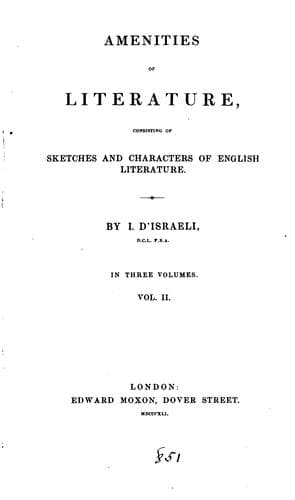
Amenities of Literature: Consisting of Sketches and Characters of English LiteratureDisraeli, Isaac
History
Amenities of Literature: Consisting of Sketches and Characters of English Literature
Disraeli, Isaac
Authors, English -- Biography; English literature -- History and criticism; Great Britain -- Intellectual life
[1] "_Poems by_ THOMAS HOCCLEVE, _never before printed, selected from
a manuscript in the possession of George Mason, with a preface,
notes, and glossary_," 1796. The notes are not amiss, and the
glossary is valuable; but the verses printed by Mason are his least
interesting productions. The poet's name is here written with an H,
as it appeared in the manuscript; but there is no need of a modern
editor changing the usual mode, because names were diversely written
or spelt even in much later times. The present writer has been called
not only _Occleve_, but _Occliffe_, as we find him in Chaucer's
works.
[2] Turner's "History of England," v. 335.
[3] No desire.
[4] Niggardly heart.
[5] A Chaucerian word, which well deserves preservation in the
language.
[6] FAVELL, author of "Lyes." FAVELL, the editor of Hoccleve,
explains as _cajolerie_, or flattery, by words given by Carpentier in
his supplement to "Du Cange." Pavel is personified by "Piers
Ploughman," and in Skelton's "Bouge of Court." FAVELE in langue
Romane is Flattery--hence _Fabel_, Fabling.--Roquefort's
"Dictionnaire." The Italian FAVELLIO, parlerie, babil,
caquet--Alberti's "Grand Dictionnaire"--does not wholly convey the
idea of our modern _Humbug_, which combines _fabling_ and _caquet_.
[7] The encumbrances to the world. In another poem he calls death
"that Coimbre-world." It was a favourite expression with him, taken
from Chaucer. See "Warton," ii. 352, note.
[8] A title which does not appear in the catalogue of his writings by
Ritson, in his "Bibliographia Poetica."
[9] Unfittingly.
[10] Weight; probably from the French _poids_.
[11] It is in Royal MS. 17 D. 6. The best is in the Harleian MS.
4866. There is also a very curious full-length preserved in a single
leaf of vellum, Sloane MS. 5141; which has been copied in Shaw's
"Dresses and Decorations of the Middle Ages," vol. i.--ED.
[12] A single trait, however, has come down to us from that other
scholar of Chaucer, whom we are next to follow. Lydgate assures us,
from what he heard, that the great poet would not suffer petty
criticisms "to perturb his reste." He did not like to groan over, and
"pinch at every blot," but always "did his best."--
My master Chaucer that founde ful many spot,
Hym lyste not gruche, nor pynch at every blot;
Nor move himself to perturb his reste;
I have perde tolde, but seyd alway his beste.
LYDGATE's "Troy."
LYDGATE; THE MONK OF BURY.
Public-domain text, read in full here on John Shaqi.
Reviews
Reviews
No reviews yet
Be the first to share your thoughts on this work.
Elsewhere in the archive
Join the Discussion
Join the discussion
Sign in to leave a comment or review.
Sign InorCreate an account