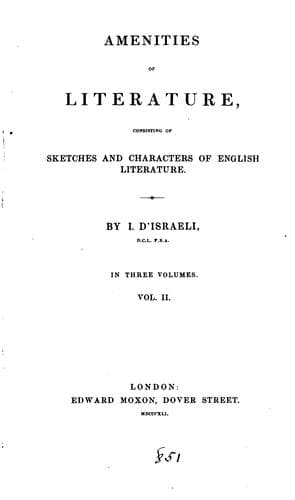
Amenities of Literature: Consisting of Sketches and Characters of English LiteratureDisraeli, Isaac
History
Amenities of Literature: Consisting of Sketches and Characters of English Literature
Disraeli, Isaac
Authors, English -- Biography; English literature -- History and criticism; Great Britain -- Intellectual life
Struck by the magnitude and the magnificence of the famous Bible of
Fust, some have decided on the invention of the art by one of its most
splendid results; this, however, is not in the usual course of human
affairs, nor in the nature of things. "The Art of Printing," observes
Dr. Cotton, in his introduction, "was brought almost to perfection in
its infancy; so that, like Minerva, it may be said to have sprung to
life, mature, vigorous, and armed for war." But in the article
"Moguntia, or Mentz," this acute researcher states that "after all that
has been written with such angry feelings upon the long-contested
question of the _origin of the Art of Printing_, Mentz appears still to
preserve the best-founded claim to the honour of being the _birth-place
of the Typographic Art_; because," he adds, "the specimens adduced in
favour of Haarlem and Strasburg, even if we should allow their
genuineness, are confessedly of _a rude and imperfect execution_." We
require no other evidence of the important fact, that the art, in its
early stages, had to pass through many transitions--from the small
school-books, or Donatuses, of Costar, to the splendid Bible of Fust.
Had the art been borrowed or stolen from a single source, according to
the popular tradition, the works would have borne a more fraternal
resemblance, and have evinced less inferiority of execution; but if
several persons at the same time were working in secrecy, each by his
own method, their differences and their inferiority would produce "the
rude and imperfect specimens." Mr. Hallam has suffered his strong
emotion on the greatness of the invention to reflect itself back on the
humble discoverers themselves; and, unusual with his searching
inquiries, calls once more on Dr. Cotton's Minerva, but with a more
celestial panoply. "The _high-minded inventors_ of this great art tried,
at _the very outset_, so bold a flight as the printing _an entire
Bible_. It was Minerva leaping on earth, in her divine strength and
radiant armour, ready at the moment of her nativity to subdue and
destroy her enemies."[3] The Bible called the Mazarine Bible, thus
distinguished from having been found in the Cardinal's library, remains
still a miracle of typography, not only for its type, but for the
quality of the paper and the sparkling blackness of its ink.[4] The
success of the art was established by this Bible; but the goldsmith
Fust, who himself was no printer, was no otherwise "high-minded," than
by the usurious prices he speculated on for this innocent imposture of
vending what was now a printed book for a manuscript copy!
No refined considerations of the nature and the universal consequences
of their discovery seem to have instigated the earliest printers; this
is evident by the perpetual jealousy and the mystifying style by which
they long attempted to hide that secret monopoly which they had now
obtained.
Public-domain text, read in full here on John Shaqi.
Reviews
Reviews
No reviews yet
Be the first to share your thoughts on this work.
Elsewhere in the archive
Join the Discussion
Join the discussion
Sign in to leave a comment or review.
Sign InorCreate an account