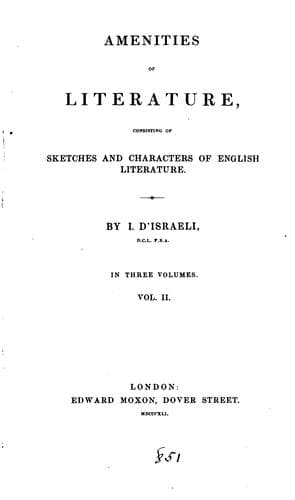
Amenities of Literature: Consisting of Sketches and Characters of English LiteratureDisraeli, Isaac
History
Amenities of Literature: Consisting of Sketches and Characters of English Literature
Disraeli, Isaac
Authors, English -- Biography; English literature -- History and criticism; Great Britain -- Intellectual life
What has happened to the art of printing also occurred to the sister-art
of engraving on copper. Tradition had ascribed the invention as the
accidental discovery of the goldsmith Maso Finiguerra. But the Germans
insist that they possess engravings before the days of the Italian
artist; and it is not doubtful that several of the compatriots of
Finiguerra were equally practising the art with himself. Heinecken would
arbitrate between the jealous patriots; he concedes that Vasari might
ascribe the invention of the art in Italy to Finiguerra, yet that
engraving might have been practised in Germany, though unknown in Italy.
Buonarotti, the great judge of all art, was sensible that in this sort
of invention every artist makes his own discoveries. Alluding to the art
of engraving, he says, "It would be sufficient to occasion our
astonishment, that the ancients did not discover the art of
chalcography, were it not known that DISCOVERIES OF THIS SORT generally
occur ACCIDENTALLY to the mechanics in the exercise of their
calling."[5] On this principle we may confidently rest. All the early
printers, like the rivals of Finiguerra at home, and his unknown
concurrents in Germany, were proceeding with the same art, and might
urge their distinct claims.
The natural magic of concave and convex lenses, those miracles of
optical science, one of which searches Nature when she eludes the eye,
and the other approximates the remotest star--the microscope and the
telescope; who were their inventors, and how have those inventions
happened? These instruments appeared about the same time. The Germans
ascribe the invention of the microscope to a Dutchman, one Drebell;
while the Neapolitan Fontana claims the anterior invention; but which
Viviani, the scholar of Galileo, asserts, from his own knowledge, was
presented to the King of Poland by that father of modern philosophy long
anterior to the date fixed on by the Germans. The history of the
telescope offers a similar result. Fracastorius may have accidentally
combined two lenses; but he neither specified the form nor the quality;
and in these consisted the real discovery, which we find in Baptista
Porta, and which subsequently was perfected by Galileo. The invention of
the art of printing seems a parallel one. It appeared in various
quarters about the same time; and in the process of successive attempts,
by intimation, by conjecture, and by experiment, each artificer
insensibly advanced into a more perfect invention; till some fortunate
claimant for the discovery puts aside all preceding essayists, who, not
without some claims to the invention, leave their advocates in another
generation to dispute about their rights, which are buried in oblivion,
or falsified by traditional legends.
Public-domain text, read in full here on John Shaqi.
Reviews
Reviews
No reviews yet
Be the first to share your thoughts on this work.
Elsewhere in the archive
Join the Discussion
Join the discussion
Sign in to leave a comment or review.
Sign InorCreate an account