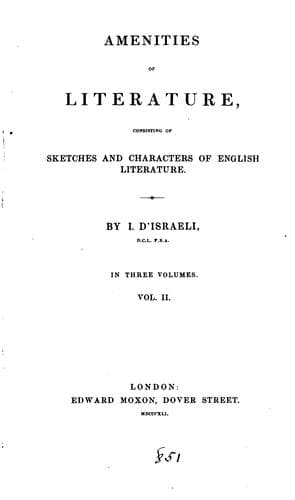
Amenities of Literature: Consisting of Sketches and Characters of English LiteratureDisraeli, Isaac
History
Amenities of Literature: Consisting of Sketches and Characters of English Literature
Disraeli, Isaac
Authors, English -- Biography; English literature -- History and criticism; Great Britain -- Intellectual life
The only certainty in the history of printing, after all the fables of
its origin, is its native place. It is a German romance enlivened by
some mysterious adventures, wanting only the opening pages, which no one
can supply.[9] Even the most philosophic of bibliographers, Daunou,
utters a cry of despair, and moreover, at this late day, seems at a
loss to decide on the nature of the influence of the art of printing!
"We live too near the epoch of the discovery of printing to judge
accurately of its influence, and too far from it to know the
circumstances which gave birth to it." Our sage seems to think that
another cycle of at least a thousand years must pass away ere we can
decide on the real influence of printing over the destinies of man: this
new tree of knowledge bears other fruit than that of its own sweetness,
source of good and evil, of sense and of nonsense! whence we pluck the
windy fruitage of opinions, crude and changeable!
How has it happened that such a plain story as that of the art of
printing should have sunk into a romance? Solely because the
monopolisers dreaded discovery. It originated in deception, and could
only flourish for their commercial spirit in mysterious obscurity. Among
the first artisans of printing every one sought to hide his work, and
even to blind the workmen. After their operations, they cautiously
unscrewed the four sides of their forms, and threw the scattered type
beneath, for, as one craftily observed to his partner, "When the
component parts of the press are in pieces, no one will understand what
they mean." One of the early printers of the fifteenth century at
Mutina, or Modena, professes his press to have been _in ædibus
subterraneis_--doubtless, if possible, still further to darken the
occult mystery. They delivered themselves in a mystical style when they
alluded to their unnamed art, and impressed on the marvelling reader
that the volume he held in his hand was the work of some supernatural
agency. They announced that the volumes in this newly-found art were
"neither drawn, nor written with a pen and ink, as all books before had
been." In the "Recuyel of the Historyes of Troye," our honest printer,
plain Caxton, caught the hyperbolical style of the dark monopolising
spirit of the confraternity. I give his words, having first spelt them.
"I have practised and learned at my great charge, and dispense to ordain
(put in order) this said book in print after the manner and form as ye
may here see, and is not written with pen and ink as other books be, to
the end that _every man may have them_ AT ONCE; for all the books of
this story, thus imprinted as ye see, were _begun in one day, and also
finished in one day_." A volume of more than seven hundred folio
pages, "begun and finished in one day," was not the less marvellous for
being impossible. But for the times was the style! Caxton would keep up
the wonder and the mystery of an art which men did not yet comprehend;
Public-domain text, read in full here on John Shaqi.
Reviews
Reviews
No reviews yet
Be the first to share your thoughts on this work.
Elsewhere in the archive
Join the Discussion
Join the discussion
Sign in to leave a comment or review.
Sign InorCreate an account