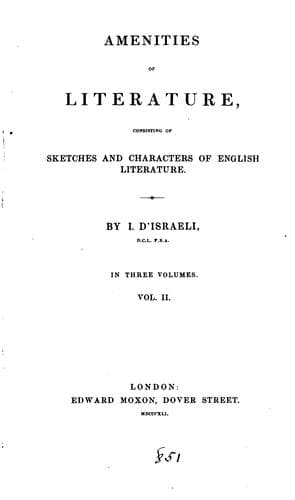
Amenities of Literature: Consisting of Sketches and Characters of English LiteratureDisraeli, Isaac
History
Amenities of Literature: Consisting of Sketches and Characters of English Literature
Disraeli, Isaac
Authors, English -- Biography; English literature -- History and criticism; Great Britain -- Intellectual life
[2] We have Caxton's own confession in his preface to "The Book of
Æneydos," or the Æneid of Virgil, where, in soliciting the
late-created poet-laureat in the University of Oxford, John Skelton,
to oversee his prose translation of the French translation, he
notices the translations of Skelton of "The Epistles of Tully," and
the "History of Diodorus Siculus," _out of Latin into English_, and
as "one that had read Virgil, Ovid, Tully, and all the other noble
poets and orators to _me unknown_."
EARLY LIBRARIES.
There probably was a time when there existed no private libraries in the
kingdom, nor any save the monastic; that of Oxford, at the close of the
thirteenth century, consisted of "a few tracts kept in chests." In that
primeval age of book-collecting, shelves were not yet required. Royalty
itself seems to have been destitute of a royal library. It appears, by
one of our recently published records, that King John borrowed a volume
from a rich abbey, and the king gave a receipt to Simon his Chancellor
for "the book called Pliny," which had been in the custody of the Abbot
and Convent of Reading. "The Romance of the History of England," with
other volumes, have also royal receipts. The king had either deposited
these volumes for security with the Abbot, or, what seems not
improbable, had no established collection which could be deemed a
library, and, as leisure or curiosity stimulated, commanded the loan of
a volume.
The borrowing of a volume was a serious concern in those days, and heavy
was the pledge or the bond required for the loan. One of the regulations
of the library of the Abbey of Croyland, Ingulphus has given. It regards
"the lending of their books, as well the smaller without pictures as the
larger with pictures;" any loan is forbidden under no less a penalty
than that of excommunication, which might possibly be a severer
punishment than the gallows.
Long after this period, our English libraries are said to have been
smaller than those on the Continent; and yet, one century and a half
subsequently to the reign of John, the royal library of France,
belonging to a monarch who loved literature, Jean le Bon, did not exceed
ten volumes. In those days they had no idea of establishing a library;
the few volumes which each monarch collected, at great cost, were always
dispersed by gifts or bequests at their death; nothing passed to their
successor but the missals, the _heures_, and the _offices_ of their
chapels. These monarchs of the thirteenth and fourteenth centuries,
amid the prevailing ignorance of the age, had not advanced in their
comprehension of the uses of a permanent library beyond their great
predecessor of the ninth, for Charlemagne had ordered his books to be
sold after his death, and the money given to the poor.
Public-domain text, read in full here on John Shaqi.
Reviews
Reviews
No reviews yet
Be the first to share your thoughts on this work.
Elsewhere in the archive
Join the Discussion
Join the discussion
Sign in to leave a comment or review.
Sign InorCreate an account