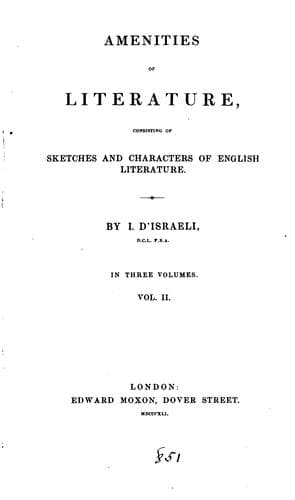
Amenities of Literature: Consisting of Sketches and Characters of English LiteratureDisraeli, Isaac
History
Amenities of Literature: Consisting of Sketches and Characters of English Literature
Disraeli, Isaac
Authors, English -- Biography; English literature -- History and criticism; Great Britain -- Intellectual life
The first chronicle in our vernacular prose, designed for the English
people, was the earnest labour of one of themselves, a citizen and
alderman, and sometime sheriff of London, ROBERT FABYAN. Here, for the
first time, the spectacle of English affairs, accompanied by what he has
called "A Concordance of Stories," which included separate notices of
French history contemporaneous with the periods he records, was opened
for "the unlettered who understand no Laten." Our chronicler, in the
accustomed mode, fixes the periods of history by dates from Adam or from
Brute. He opens with a superfluous abridgment of Geoffry of
Monmouth--the "Polychronicon" is one of his favourite sources, but his
authorities are multifarious. His French history is a small stream from
"La Mere des Chroniques," and other chronicles of his contemporary
Gaguin, a royal historiographer who wandered in the same taste, but who,
Fabyan had the sagacity to discover, carefully darkened all matters
unpleasant to Frenchmen, but never "leaving anything out of his book
that may sound to the advancement of the French nacyon."
It was a rare occurrence in a layman, and moreover a merchant, to have
cultivated the French and the Latin languages. Fabyan was not a learned
man, for the age of men of learning had not yet arrived, though it was
soon to come. At that early day of our typography, when our native
annalists lay scattered in their manuscript seclusion, it was no
ordinary delving which struck into the dispersed veins of the dim and
dark mine of our history. So little in that day was the critical
knowledge of our writers, that Fabyan has "quoted the same work under
different appellations," and some of our historical writers he seems not
to have met with in his researches, for the chronicles of Robert of
Gloucester and of Peter Langtoft, though but verse, would have
contributed some freshness to his own. In seven unequal divisions, the
chronicle closes with the days of the seventh Henry. These seven
divisions were probably more fantastical than critical; the number was
adopted to cheer the good man with "the seven joys of the Virgin," which
he sings forth in unmetrical metre, evidently participating in the
rapturous termination of each of his own "seven joys."
Our grave chronicler, arrayed in his civic dignities, seems to have
provoked the sensitiveness of the poetical critic in Warton, and the
caustic wit in Horace Walpole. "No sheriff," exclaims Walpole, "was ever
less qualified to write a history of England. He mentions the deaths of
princes and revolutions of government with the same phlegm and brevity
as he would speak of the appointment of churchwardens."
Public-domain text, read in full here on John Shaqi.
Reviews
Reviews
No reviews yet
Be the first to share your thoughts on this work.
Elsewhere in the archive
Join the Discussion
Join the discussion
Sign in to leave a comment or review.
Sign InorCreate an account