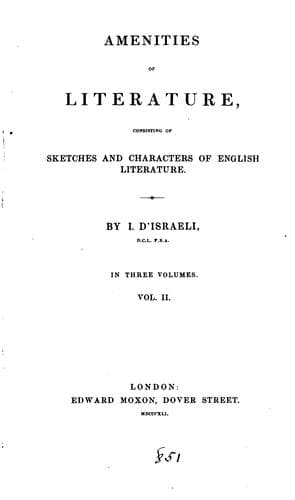
Amenities of Literature: Consisting of Sketches and Characters of English LiteratureDisraeli, Isaac
History
Amenities of Literature: Consisting of Sketches and Characters of English Literature
Disraeli, Isaac
Authors, English -- Biography; English literature -- History and criticism; Great Britain -- Intellectual life
Our pristine chronicler, as we have seen, has received hard measure from
the two eminent critics of the eighteenth century, who have censured as
a history that which is none. Chronicles were written when the science
of true history had yet no existence; a chronicle then in reality is but
a part of history. Every fact dispersed in its insulated state refuses
all combination; cause and effect lie remote and obscured from each
other; disguised by their ostensible pretexts, the true motives of
actions in the great actors of the drama of history cannot be found in
the chronological chronicler. The real value of his diligence consists
in copiousness and discrimination; qualities rather adverse to each
other. FABYAN betrays the infirmities of the early chronicler, not yet
practised even in the art of simple detail, without distinction of the
importance or the insignificance of the matters he records: his eager
pen reckoned the number without knowing to test the weight; to him all
facts appeared of equal worth, for all alike had cost him the same toil;
and thus he yields an abundance without copiousness. In raising the
curiosity which he has not satisfied for us, his mighty tome shrinks
into a narrow scope, and his imperfect narratives, brief and dry, offer
only the skeletons of history. The mere antiquarian indeed prefers the
chronicle to the history; the acquisition of a fact with him is the
limit of his knowledge, and he is apt to dream that he possesses the
superstructure when he is only at work on the foundations.
The Chronicle of FABYAN attracts our notice for a remarkable incident
attending its publication. The Chronicle was finished in 1504, and
remained in manuscript during the author's life, who died in 1512. The
first edition did not appear till 1516. The cause which delayed the
printing of an important work, for such it was in that day, has not been
disclosed; yet perhaps we might have been interested to have learned
whether this protracted publication arose out of neglect difficult to
comprehend, or from the printer, reluctant to risk the cost, or from any
impediment from a higher quarter.
Public-domain text, read in full here on John Shaqi.
Reviews
Reviews
No reviews yet
Be the first to share your thoughts on this work.
Elsewhere in the archive
Join the Discussion
Join the discussion
Sign in to leave a comment or review.
Sign InorCreate an account