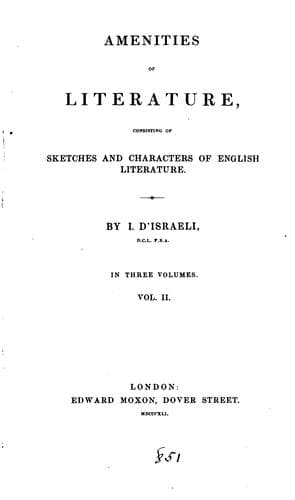
Amenities of Literature: Consisting of Sketches and Characters of English LiteratureDisraeli, Isaac
History
Amenities of Literature: Consisting of Sketches and Characters of English Literature
Disraeli, Isaac
Authors, English -- Biography; English literature -- History and criticism; Great Britain -- Intellectual life
Andrew Borde was one of those eccentric geniuses who live in their own
sphere, moving on principles which do not guide the routine of society.
He was a Carthusian friar; his hair-shirt, however, could never mortify
his unvarying facetiousness; but if he ever rambled in his wits, he was
a wider rambler, even beyond the boundaries of Christendom, "a thousand
or two and more myles;" an extraordinary feat in his day. He took his
degree at Montpelier, was incorporated at Oxford, and admitted into the
College of Physicians in London, and was among the physicians of Henry
the Eighth. His facetious genius could not conceal the real learning and
the practical knowledge which he derived from personal observation.
Borde has received hard measure from our literary historians. This
ingenious scholar has been branded by Warton as a mad physician. To
close the story of one who was all his days so facetious, we find that
this Momus of philosophers died in the Fleet. This was the fate of a
great humorist, neither wanting in learning or genius.
It is said that such was his love of "the commonwealth," that he
sometimes addressed them from an open stage, in a sort of gratuitous
lecture, as some amateurs of our own days have delighted to deliver; and
from whence has been handed down to us the term of "MERRY-ANDREW."
In the limited circles which then divided society, the taste for humour
was very low. We had not yet reached to the witty humours of Shakspeare
and Jonson. Sir Thomas More's "Long Story," in endless stanzas, which
Johnson has strangely placed among the specimens of the English
language, was held as a tale of "infinite conceit," assuredly by the
great author himself, who seems to have communicated this sort of taste
to one of his family. Rastall, the learned printer, brother-in-law of
More, and farther, the grave abbreviator of the statutes in English,
issued from his press in 1525, "The Widow Edith's Twelve Merrie Gestys."
She was a tricking widow, renowned for her "lying, weeping, and
laughing," an ancient mumper, who had triumphed over the whole state
spiritual, and the temporality: travelling from town to town in the full
practice of dupery and wheedling, to the admiration of her numerous
victims. The arts of cheatery were long held to be facetious; most of
the "Merrie Jests" consist of stultifying fools, or are sharping tricks,
practised on the simple children of dupery. There is a stock of this
base coinage. This taste for dupery was carried down to a much later
period; for the "Merrie conceited jests of George Peele," and of
Tarleton, are chiefly tricks of sharpers.
Public-domain text, read in full here on John Shaqi.
Reviews
Reviews
No reviews yet
Be the first to share your thoughts on this work.
Elsewhere in the archive
Join the Discussion
Join the discussion
Sign in to leave a comment or review.
Sign InorCreate an account