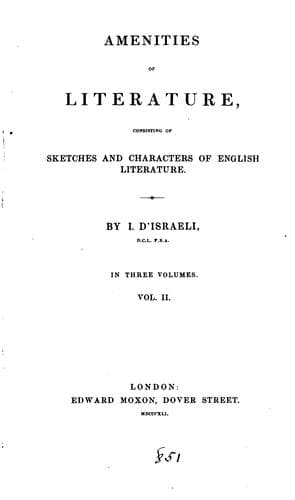
Amenities of Literature: Consisting of Sketches and Characters of English LiteratureDisraeli, Isaac
History
Amenities of Literature: Consisting of Sketches and Characters of English Literature
Disraeli, Isaac
Authors, English -- Biography; English literature -- History and criticism; Great Britain -- Intellectual life
At that day they were bewildered in their notions of property, and their
standards of value; they had neither discovered the sources nor the
progress of the wealth of a nation. They murmured at importation, for
which they seemed to pay the penalties, and looked on exportation as a
conveyance of the national property to the foreigner. They fixed the
prices at which all consumable articles were to be sold; the farmer's
garner was inspected; the landlords who became graziers were denounced;
forestallers and regraters haunted the privy councils of the king; the
markets were never better supplied; and the people wondered why every
article was dearer. About this time the prices of all commodities, both
in France and England, had gradually risen. The enterprise of commerce
was probably working on larger capitals. As expenses increased, the
landlords held that they were entitled to higher rents. In Crowley's
denunciations, "God's plague" is invoked against all "lease-mongers,
pilling and polling the poor commoner." The Parliament of Henry the
Eighth had legalized the interest of money at ten per cent.; Robin would
have this "sinful act" repealed: loans should be gratuitous by the
admonition in Luke, "Do ye lend, looking for no gain thereof." In this
manner he applies the text against usury. They seemed to have no notion
that he who bought ever intended to sell. This rude political economist
proposed that all property should be kept stationary. No one should have
a better portion than he was born to. Where then was to be found the
portion of "the poor commoner" not born to any? or him whose loss of
fortune was to be repaired by industry and enterprise? Prices advanced;
double rents! double tithes! Our radical preacher attacks his brother
ecclesiastics. "We can neither come into the world, nor remain in it,
nor go out of it, but they must have a fleece! Let it be lawful to
perform all their ministries by ourselves; we can lay an honest man in
his grave without a set of carrion-crows scenting their prey." The
splendour of the ancient landed aristocracy and the prodigal luxury of
the ecclesiastics more forcibly struck their minds than those silent
arts of enlarged traffic which were perpetuating the wealth of the
nation, and producing its concomitant evils.
Public-domain text, read in full here on John Shaqi.
Reviews
Reviews
No reviews yet
Be the first to share your thoughts on this work.
Elsewhere in the archive
Join the Discussion
Join the discussion
Sign in to leave a comment or review.
Sign InorCreate an account