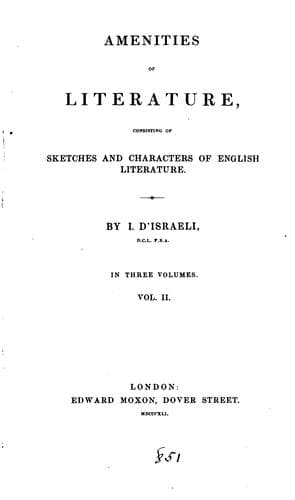
Amenities of Literature: Consisting of Sketches and Characters of English LiteratureDisraeli, Isaac
History
Amenities of Literature: Consisting of Sketches and Characters of English Literature
Disraeli, Isaac
Authors, English -- Biography; English literature -- History and criticism; Great Britain -- Intellectual life
[7] Perhaps the very last remains of such rude dramatic exhibitions
are yet to be traced in our counties--about Christmas-tide, or rather
old Christmas, whose decrepit age is personified. In Lancashire and
Yorkshire, and also in Dorsetshire, families are visited by "the
great Emperor of the Turks" and St. George of England, or by the
lion-hearted Richard. After a fierce onset, ringing their tin swords,
the Saracens groan and drop. The Leech appears holding his phial;
from some drops the dead survive their fate, and rise for the
hospitable supper. The dialogue, however, has not been so traditional
as the exhibition. The curious portion of these ancient exhibitions
is, therefore, totally lost in the substitutions of the rude rustics.
The Wassail Songs, or the Christmas Carols, have come down with fewer
losses than these ancient "Tales of the Crusaders;" for the language
of emotion, and the notice of old picturesque customs, cling to the
memory, and endure with their localities. But for these we must
travel far from the land of the Cockneys.
[8] Bouterwek.
[9] The clergy long continued to assist at these exhibitions, if they
did not always act in them. In 1417, an _English Mystery_ was
exhibited before the Emperor Sigismund, at the Council of Constance,
on the usual subject of the Nativity. The _English Bishops_ had it
rehearsed several days, that the actors might be perfect before their
imperial audience. We are not told in what language their _English
Mystery_ was recited; but we are furnished with a curious fact, that
"the Germans consider this play as the first introduction of that
sort of dramatic performance in their country."--"Henry of Monmouth,"
by the Rev. J. E. Tyler, ii. 61.
[10] The Spanish nation, unchangeable in their customs, have retained
the last remains of the ancient Mysteries in the divisions of their
dramas, called "Jornadas."
[11] "A sheep-skin for Jews, wigs for the Apostles, and vizards for
Devils," appear in the churchwardens' accounts at Tewkesbury, 1578,
"for the players' geers."--"Hist. of Dramatic Poetry," ii. 140. The
same diligent inquirer has also discovered the theatrical term
"properties," in allusion to the furniture of the stage, and which is
so used by Shakspeare, employed in its present sense in an ancient
morality.--Ib. ii. 129.
[12] "Reliques of Ancient Poetry," i. 129.
[13] "Dictionnaire de l'Académie Française."--The proverbial phrase
is accompanied by a very superfluous remark--"Ce mot a passé d'usage
avec les moeurs de ces temps anciens." See also "Dict. de Trevoux,"
art. _Mystère_.
Public-domain text, read in full here on John Shaqi.
Reviews
Reviews
No reviews yet
Be the first to share your thoughts on this work.
Elsewhere in the archive
Join the Discussion
Join the discussion
Sign in to leave a comment or review.
Sign InorCreate an account