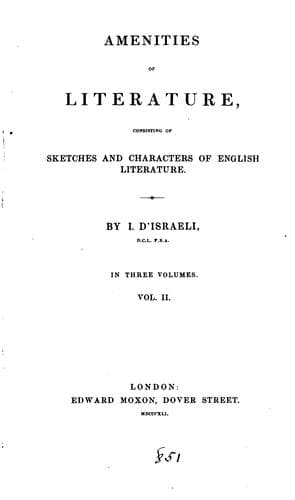
Amenities of Literature: Consisting of Sketches and Characters of English Literature — John Shaqi
Amenities of Literature: Consisting of Sketches and Characters of English LiteratureDisraeli, Isaac
History
Amenities of Literature: Consisting of Sketches and Characters of English Literature
Disraeli, Isaac
Authors, English -- Biography; English literature -- History and criticism; Great Britain -- Intellectual life
We discover these heroes, Danes or Angles, as we find them in the
Homeric period, audacious with the self-confidence of their bodily
prowess; vaunting, and talkative of their sires and of themselves; the
son ever known by denoting the father, and the father by his marriage
alliance--that primitive mode of recognition, at a period when, amid the
perpetual conflicts of rival chieftains, scarcely any but relations
could be friends; the family bond was a sure claim to protection. Like
the Homeric heroes, they were as unrelenting in their hatreds as
indissoluble in their partisanship; suspicious of the stranger, but
welcoming the guest; we find them rapacious, for plunder was their
treasure, and prodigal in their distributions of their golden armlets
and weighed silver, for their egotism was as boundless as their
violence. Yet pride and glory fermented the coarse leaven of these
mighty marauders, who were even chivalric ere chivalry rose into an
order. The religion of these ages was wild as their morality; few heroes
but bore some relationship to Woden; and even in their rude paganised
Christianity, some mythological name cast its lustre in their
genealogies. In the uncritical chronicles of the middle ages it is not
always evident whether the mortal was not a divinity. Their mythic
legends have thrown confusion into their national annals, often accepted
by historians as authentic records.[2] But if antiquaries still wander
among shadows, the poet cannot err. BEOWULF may be a god or a nonentity,
but the poem which records his exploits must at least be true, true in
the manners it paints and the emotions which the poet reveals--the
emotions of his contemporaries.
BEOWULF,[3] a chieftain of the Western Danes, was the Achilles of the
North. We first view him with his followers landing on the shores of a
Danish kingling. A single ship with an armed company, in those predatory
days, could alarm a whole realm. The petty independent provinces of
Greece afford a parallel; for Thucydides has marked this period in
society, when plunder well fought for was honoured as an heroic
enterprise. When a vessel touched on a strange shore, the adventurers
were questioned "whether they were thieves?" a designation which the
inquirers did not intend as a term of reproach, nor was it scorned by
the valiant;[4] for the spoliation of foreigners, at a time when the law
of nations had no existence, seemed no disgrace, while it carried with
it something of glory, when the chieftain's sword maintained the swarm
of his followers, or acquired for himself an extended dominion.
Beowulf was a mailed knight, and his gilded ensign hung like a meteor in
the air, and none knew the fate it portended. The warder of the coast,
for in those days many a warder kept "ocean-watch" on the sea-cliffs,
takes horse, and hastens to the invader; fearlessly he asks, "Whence,
and what are ye? Soonest were best to give me answer."
Public-domain text, read in full here on John Shaqi.
Reviews
Reviews
No reviews yet
Be the first to share your thoughts on this work.
Join the Discussion
Join the discussion
Sign in to leave a comment or review.
Sign InorCreate an account