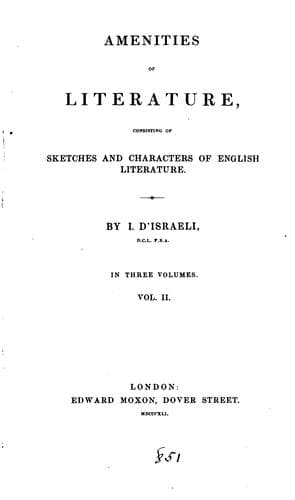
Amenities of Literature: Consisting of Sketches and Characters of English Literature — John Shaqi
Amenities of Literature: Consisting of Sketches and Characters of English LiteratureDisraeli, Isaac
History
Amenities of Literature: Consisting of Sketches and Characters of English Literature
Disraeli, Isaac
Authors, English -- Biography; English literature -- History and criticism; Great Britain -- Intellectual life
[17] _L'Angeleida_ of VALVASONE, the _Adamo_ of ANDREINI, and
others.--Hayley's Conjectures on the Origin of "Paradise Lost." See
also Tiraboschi, and Ginguéné.
[18] These singular attempts at art may be inspected in above fifty
plates, in the Archæologia, vol. xx. We may rejoice at their
preservation, for art, even in the attempts of its children, may
excite ideas which might not else have occurred to us.
BEOWULF; THE HERO-LIFE.
The Anglo-Saxon poetical narrative of "The Exploits of Beowulf" forms a
striking contrast with the chronological paraphrase of Cædmon. Its
genuine antiquity unquestionably renders it a singular curiosity; but it
derives an additional interest from its representation of the primitive
simplicity of a Homeric period--the infancy of customs and manners and
emotions of that Hero-life, which the Homeric poems first painted for
mankind:--that Hero-life of which Macpherson in his Ossian caught but
imperfect conceptions from the fragments he may have collected, while he
metamorphosed his ideal Celtic heroes into those of the sentimental
romance of another age and another race.
The northern hordes under their petty chieftains, cast into a parallel
position with those princes of Greece whose realms were provinces, and
whose people were tribes, often resembled them in the like
circumstances, the like characters, and the like manners. Such were
those kinglings who could possess themselves of a territory in a single
incursion, and whose younger brothers, stealing out of their lone bays,
extended their dominion as "Sea-Kings" on the illimitable ocean.[1] The
war-ship and the mead-hall bring us back to that early era of society,
when great men knew only to be heroes, flattered by their bards, whose
songs are ever the echoes of their age and their patrons.
Public-domain text, read in full here on John Shaqi.
Reviews
Reviews
No reviews yet
Be the first to share your thoughts on this work.
Join the Discussion
Join the discussion
Sign in to leave a comment or review.
Sign InorCreate an account