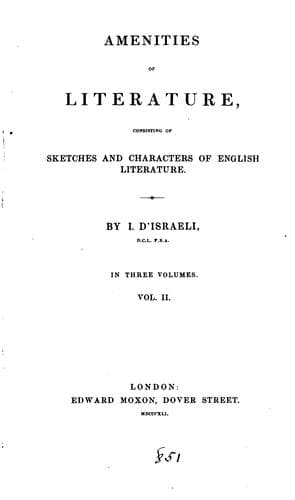
Amenities of Literature: Consisting of Sketches and Characters of English LiteratureDisraeli, Isaac
History
Amenities of Literature: Consisting of Sketches and Characters of English Literature
Disraeli, Isaac
Authors, English -- Biography; English literature -- History and criticism; Great Britain -- Intellectual life
The hero had come not to seek feud, nor to provoke insult, but with the
free offering of his own life to relieve the sovereign of the Eastern
Danes, whose thanes, for twelve years, had vainly perished, struggling
with a mysterious being--one of the accursed progeny of Cain--a foul
and solitary creature of the morass and the marsh. In the dead of the
night this enemy of man, envious of glory and abhorrent of pleasure,
glided into the great hall of state and revelry, raging athirst for the
blood of the brave there reposing in slumber. The tale had spread in
songs through all Gothland. This life-devourer, who comes veiled in a
mist from the marshes, may be some mythic being; but though monstrous,
it does little more than play the part of the Polyphemus of antiquity
and the Ogre of modern fairyism.
In the timber-palace chambers were but small and few, and the guests of
the petty sovereign slept in the one great hall, under whose echoing
roof the Witenagemot assembled, and the royal banquet was held; there
each man had his "bed and bolster" laid out, with his shield at his
head, and his helmet, breastplate, and spear placed on a rack beside
him--"at all times ready for combat both in house and field."
This scene is truly Homeric; and thus we find in the early state of
Greece, for the historian records this continual wearing of armour,
_like the barbarians_, because "their houses were unfenced, and
travelling was unsafe."[5]
The watchman of the seas leaves not the coast, duteous in his lonely
cares; while Beowulf, with his companions, marches onwards. They came to
where the streets were paved; an indication in that age of a regal
residence. The iron rings in their mailed coats rang as they trod in
their "terrible armour." They reach the king's house; they hang up their
shields against the lofty wall. They seat themselves on a bench, placing
in a circle their mailed coats, their bucklers, and their javelins. This
warlike array called forth an Ulysses, "famed for war and wisdom;" they
parley; the thane hastens to announce the warlike but the friendly
visitor; and the hero, so famed for valour, yet would not obtrude his
person, standing behind the thane, "for he knew the rule of ceremony."
The prince of the East Danes joyfully exclaims, that "he had known
Beowulf when a child; he remembered the name of his father, who married
the only daughter of Hrethel the Goth. It is said that he has the
strength of thirty men in the grip of his hand. God only could have
sent him."
Public-domain text, read in full here on John Shaqi.
Reviews
Reviews
No reviews yet
Be the first to share your thoughts on this work.
Join the Discussion
Join the discussion
Sign in to leave a comment or review.
Sign InorCreate an account