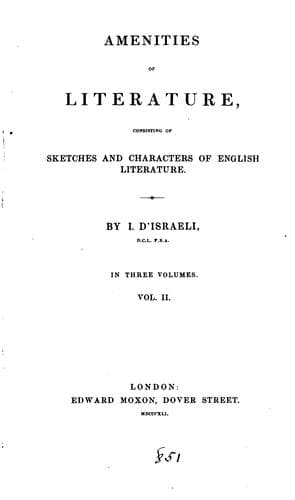
Amenities of Literature: Consisting of Sketches and Characters of English LiteratureDisraeli, Isaac
History
Amenities of Literature: Consisting of Sketches and Characters of English Literature
Disraeli, Isaac
Authors, English -- Biography; English literature -- History and criticism; Great Britain -- Intellectual life
Our Henry the Third was a prodigal patron of these Anglo-Norman poets.
This monarch awarded to a romancer, Rusticien de Pise, who has
proclaimed the regal munificence to the world, a couple of fine
"chateaux," which I would not, however, translate as has been done by
the English term "castles." Well might a romancer so richly remunerated
promise his royal patron to finish "The Book of Brut," the never-ending
theme to the ear of a British monarch who, indeed, was anxious to
possess such an authentic state-paper. Who this Rusticien de Pise was,
one cannot be certain; but he was one of a numerous brood who,
stimulated by "largesses" and fair chateaux, delighted to celebrate the
chivalry of the British court, to them a perpetual fountain of honour
and preferment. We may now smile at the Count de Tressan's querulous
nationality, who is indignant that the writers of the French romances of
the Round Table show a marked affectation of dwelling on everything that
can contribute to the glory of the throne and court of England,
preferring a fabulous Arthur to a true Charlemagne, and English knights
to French paladins.[8] When Tressan wrote, this striking circumstance
had not received its true elucidation; the hand of these writers had
only flowed with their gratitude; these writers composed to gratify
their sovereign, or some noble patron at the English court, for they
were English natives or English subjects, long concealed from posterity
as Englishmen by writing in French. It had then escaped the notice of
our literary antiquaries at home and abroad, that these Englishmen could
have composed in no other language. How imperfect is the catalogue of
early English poets by Ritson! for it is since his day that this
important fact in our own literary history has been acknowledged by the
French themselves, who at length have distinguished between Norman and
Anglo-Norman poets. M. Guizot was enabled by the French government to
indulge his literary patriotism by sending a skilful collector to
England to search in our libraries for Norman writings; and we are told
that none but Anglo-Norman writers have been found--that is, Englishmen
writing on English affairs, and so English that they have not always
avoided an unguarded expression of their dislike of foreigners, and even
of Normans!
It is worthy of observation, that even those Norman writers who came
young into England soon took the colour of the soil; and what rather
surprises us, considering the fashion of the court at that period,
studied the original national language, translated our Saxon writings,
and often mingled in their French verse phrases and terms which to this
day we recognise as English. Of this we have an interesting evidence in
an Anglo-Norman poetess, but recently known by the name of "Marie de
France;" yet had she not written this single verse accidentally--
Me nummerai par remembrance,
_Marie ai num, si sui de France_--
Public-domain text, read in full here on John Shaqi.
Reviews
Reviews
No reviews yet
Be the first to share your thoughts on this work.
Elsewhere in the archive
Join the Discussion
Join the discussion
Sign in to leave a comment or review.
Sign InorCreate an account