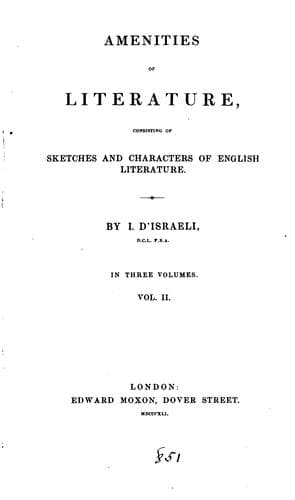
Amenities of Literature: Consisting of Sketches and Characters of English LiteratureDisraeli, Isaac
History
Amenities of Literature: Consisting of Sketches and Characters of English Literature
Disraeli, Isaac
Authors, English -- Biography; English literature -- History and criticism; Great Britain -- Intellectual life
we should from her subjects, and her perfect knowledge of the vernacular
idiom of the English, have placed this Sappho of the thirteenth century
among the women of England. This poetess tells us that she had turned
into her French rhymed verse the Æsopian Fables, which one of our kings
had translated into English from the Latin. This royal author could have
been no other than Alfred, to whom such a collection has been ascribed.
We learn from herself the occasion of her version. Her task was
performed for a great personage who read neither Latin nor English; it
was done for "the _love_ of the renowned Earl William Longsword"--
----Cunte Willaume,
Le plus vaillant de cest Royaume.
Who would calculate the "largesse" "Count William," this puissant
Longsword, cast into the lap of this living muse when she offered all
this melodious wisdom; whose beautiful simplicity a child might
comprehend, but whose moral and politic truths would throw even the
Norman Longsword into a state of rational musing? Her "Lais," short but
wild "Breton Tales," which our poetess dedicated to her sovereign, our
Henry the Third, are evidence that Marie could also skilfully touch the
heart and amuse the fancy.
In her poems, Marie has translated many French terms into pure English,
and abounds with allusions to English places and towns whose names have
not changed since the thirteenth century. Her local allusions, and her
familiar knowledge of the vernacular idiom of the English people, prove
that "Marie," though by the accident of birth she may be claimed by
France, yet by her early and permanent residence, and by the constant
subjects of her writings, her "Breton Tales," and her "Fables" from the
English, by her habits and her sympathies, was an Englishwoman.
At this extraordinary period when England was a foreign kingdom, the
English people found some solitary friends--and these were the rustic
monk and the itinerant minstrel, for they were Saxons, but subjects too
mean and remote for the gripe of the Norman, occupied in rooting out
their lords to plant his own for ever in the Saxon soil.
Public-domain text, read in full here on John Shaqi.
Reviews
Reviews
No reviews yet
Be the first to share your thoughts on this work.
Elsewhere in the archive
Join the Discussion
Join the discussion
Sign in to leave a comment or review.
Sign InorCreate an account