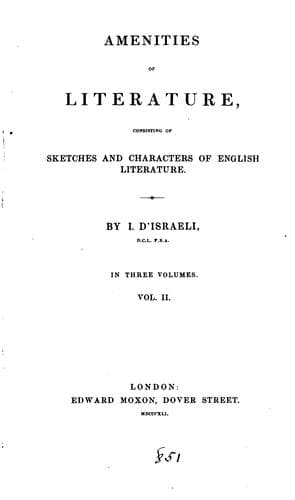
Amenities of Literature: Consisting of Sketches and Characters of English LiteratureDisraeli, Isaac
History
Amenities of Literature: Consisting of Sketches and Characters of English Literature
Disraeli, Isaac
Authors, English -- Biography; English literature -- History and criticism; Great Britain -- Intellectual life
The true language of the people lingered on their lips, and it seemed to
bestow a shadowy independence to a population in bondage. The remoter
the locality, the more obdurate was the Saxon; and these indwellers were
latterly distinguished as "Uplandish" by the inhabitants of cities. For
about two centuries "the Uplandish" held no social connexion; separated
not only by distance, but by their isolated dialects and peculiar
customs, these natives of the soil shrunk into themselves, intermarrying
and dying on the same spot; they were hardly aware that they were
without a country.
It was a great result of the Norman government in England that it
associated our insular and retired dominion with that nobler theatre of
human affairs, the Continent of Europe. In Normandy we trace the first
footings of our national power; the English Sovereign, now a prince of
France, ere long on the French soil vied in magnitude of territory with
his paramount Lord, the Monarch of France. Such a permanent connexion
could not fail to produce a conformity in manners; what was passing
among our closest neighbours, rivals or associates, was reflected in the
old Saxon land which had lost its nationality.
FOOTNOTES:
[1] Speed, 441. This was said to "the Conqueror," and this Abbot of
St. Alban's paid dearly for the patriotism which had then become
treason.
[2] A circumstance which Milton has recorded.
[3] Our great lawyers probably imagined that the honour of the
country is implicated in the title usually accorded to William the
Norman; SPELMAN, the great antiquary, and BLACKSTONE, the historian
and the expounder of our laws, have absolutely explained away the
assumed title of "the Conqueror" to a mere technical feudal term of
"_Conquestor, or acquirer of any estate out of the common course of
inheritance_." The first purchaser (that is, he who brought the
estate into the family which at present owns it) was styled "the
Conqueror," _and such is still the proper phrase in the law of
Scotland_. RITSON is indignant at what he calls "a pitiful forensic
quibble."
But another great lawyer and lord chancellor, the sedate WHITELOCKE,
positively asserts that "William only conquered Harold and his army;
for he never was, nor _pretended to be_, the conqueror of England,
although the _sycophant monks of the time_ gave him that
title."--Whitelocke's "Hist. of England," 33.
Public-domain text, read in full here on John Shaqi.
Reviews
Reviews
No reviews yet
Be the first to share your thoughts on this work.
Elsewhere in the archive
Join the Discussion
Join the discussion
Sign in to leave a comment or review.
Sign InorCreate an account