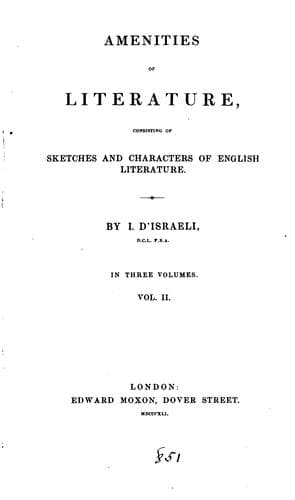
Amenities of Literature: Consisting of Sketches and Characters of English LiteratureDisraeli, Isaac
History
Amenities of Literature: Consisting of Sketches and Characters of English Literature
Disraeli, Isaac
Authors, English -- Biography; English literature -- History and criticism; Great Britain -- Intellectual life
The monks, who lived rusticated in their scattered monasteries,
sojourners in the midst of their conquered land, often felt their Saxon
blood tingle in their veins. Not only did the filial love of their
country deepen their sympathies, but a more personal indignation rankled
in their secret bosoms at the foreign intruders, French or Italian--the
tyrannical bishop and the voluptuous abbot. There were indeed monks, and
some have been our chroniclers, base-born, humiliated, and living in
fear, who in their leiger-books, when they alluded to their new
masters, called them "the conquerors," noticed the year when some
"conqueror" came in, and recorded what "the conquerors" had enacted. All
these "conquerors" designated the foreigners, who were the heads of
their houses. But there were other truer Saxons. Inspired equally by
their public and their private feeling, these were the first who,
throwing aside both Latin and French, addressed the people in the only
language intelligible to them. The patriotic monks decided that the
people should be reminded that they were Saxons, and they continued
their history in their own language.
This precious relic has come down to us--the "Saxon Chronicle"[9]--but
which in fact is a collection of chronicles made by different persons.
These Saxon annalists had been eye-witnesses of the transactions they
recorded, and this singular detail of incidents as they occurred without
comment is a phenomenon in the history of mankind, like that of the
history of the Jews contained in the Old Testament, and, like that, as
its learned editor has ably observed, "a regular and chronological
panorama of a people described in rapid succession by different writers
through many ages in their own VERNACULAR LANGUAGE." The mutations in
the language of this ancient chronicle are as remarkable as the fortunes
of the nation in its progress from rudeness to refinement; nor less
observable are the entries in this great political register from the
year One of Christ till 1154, when it abruptly terminates. The
meagreness of the earlier recorders contrasts with the more impressive
detail of later enlarged and thoughtful minds. When we come to William
of Normandy, we have a character of that monarch by one who knew him
personally, having lived at his court. It is not only a masterly
delineation, but a skilful and steady dissection. The earlier Saxon
chronicler has recorded a defeat and retreat which Cæsar suffered in his
first invasion, which would be difficult to discover in the Commentaries
of Cæsar.
Public-domain text, read in full here on John Shaqi.
Reviews
Reviews
No reviews yet
Be the first to share your thoughts on this work.
Elsewhere in the archive
Join the Discussion
Join the discussion
Sign in to leave a comment or review.
Sign InorCreate an account