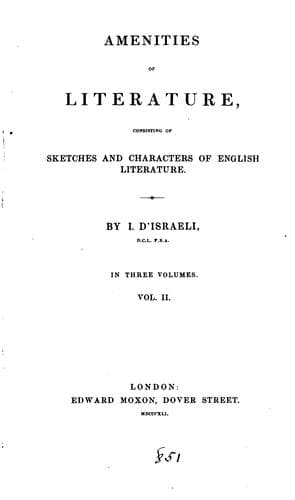
Amenities of Literature: Consisting of Sketches and Characters of English LiteratureDisraeli, Isaac
History
Amenities of Literature: Consisting of Sketches and Characters of English Literature
Disraeli, Isaac
Authors, English -- Biography; English literature -- History and criticism; Great Britain -- Intellectual life
If in these ages of romance and romancers the fair sex were rarely
approached without the devotion of idolatry, whenever "the course of
true love" altered--when the frail spirit loved too late and should not
have loved, the punishment became more criminal than the crime; for
there was more of selfish revenge and terrific malignity than of
justice, when autocratical man became the executioner of his own decree.
The domestic chronicles of these times exhibit such harrowing incidents
as those of _La Châtelaine de Vergy_, where suddenly a scene of
immolation struck through the devoted household; or that of "La Dame du
Fayel,"[9] who was made to eat her lover's heart. And those who had not
to punish, but to put to trial, the affections of women who were in
their power, had their terrible caprices, a ferocity in their barbarous
loves. Year after year the Gothic lord failed to subdue the immortalised
patience of Griselda, and such was our "Childe Waters," who put to such
trials of passion, physical and mental, the maiden almost a mother. In
the fourteenth century, one century later than the histories of the
"_Châtelaine_" and the "_Dame_," either the female character was
sometimes utterly dissolute, or the tyranny of husbands utterly
reckless, when we find that it was no uncommon circumstance that women
were strangled by masked assassins, or walking by the riverside were
plunged into it. This drowning of women gave rise to a popular
proverb--"It is nothing! only a woman being drowned." La Fontaine,
probably without being aware of this allusion to a practice of the
fourteenth century, has preserved the proverbial phrase in his "La Femme
noyée," beginning,
Je ne suis pas de ceux qui disent ce n'est rien,
C'est une Femme qui se noye![10]
The personages and the manners here imperfectly sketched, constituted
the domestic life of our chivalric society from the twelfth century to
the first civil wars of England. In this long interval few could read;
even bishops could not always write; and the Gothic baron pleaded the
privilege of a layman for not doing the one nor the other.
The intellectual character of the nation can only be traced in the
wandering minstrel and the haughty ecclesiastic. The minstrel mingling
with all the classes of society reflected all their sympathies, and in
reality was one of the people themselves; but the ecclesiastic stood
apart, too sacred to be touched, while his very language was not that
either of the noble or of the people.
Public-domain text, read in full here on John Shaqi.
Reviews
Reviews
No reviews yet
Be the first to share your thoughts on this work.
Elsewhere in the archive
Join the Discussion
Join the discussion
Sign in to leave a comment or review.
Sign InorCreate an account