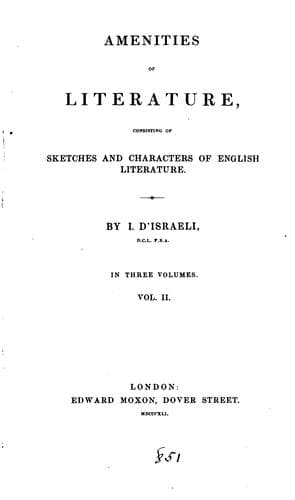
Amenities of Literature: Consisting of Sketches and Characters of English LiteratureDisraeli, Isaac
History
Amenities of Literature: Consisting of Sketches and Characters of English Literature
Disraeli, Isaac
Authors, English -- Biography; English literature -- History and criticism; Great Britain -- Intellectual life
[1] St. Palaye, to whom we owe the ideal of chivalry, has truly
observed, "Toutes les vertus recommandées par la Chevalerie
tournoient au bien public, au profit de l'Etat." It was when the
causes of its institution ceased, and nothing remained but its forms
without its motive, that altered manners could safely ridicule some
noble qualities which, though now displaced, have not always found
equal substitutes. In the advancement of society we may count some
losses.
[2] I recollect this trait in Chaucer. The Norway hawk was among the
most valuable articles of property, valued at a sum equal to £300 of
the present day.--Nicholls, "History of Leicestershire," xxxix.
[3] The Norman William punished men with loss of eyes for taking his
venery.--Selden's notes to "Drayton's Polyolbion," Song ii.
An instant execution of two youths by the gamekeepers, at the command
of their Lord, appears in an ancient romance recently published in
France.--_Journal des Savans_, 1838.
[4] A curious specimen of these "Household Books," though of a later
period, is that of the Northumberland family, printed by Bishop
Percy. Many exist in manuscript, and contain particulars more
valuable than the prices of commodities, for which they are usually
valued; they offer striking pictures of the manners of their age.
[The Wardrobe accounts of Edward the Fourth, the Privy Purse expenses
of Edward IV. and Henry VIII., have been since published by Sir
Harris Nicolas; and those of the Princess Mary, afterwards Queen, by
Sir Frederick Madden. The judicious notes and dissertations of these
editors render them of much use in illustration of the history of
each era.--ED.]
[5] "Warton," i. 94.
[6] "Warton," ii. 412.
[7] Stowe's "Survey by Strype," book iii. 235. We might wish to learn
the authority of Stowe for ascribing this "pleasant wit" to Rahere of
the eleventh century! As the pen of venerable Stowe never moved idly,
our antiquary must have had some information which is now lost. "The
king's minstrel" is also a doubtful designation: was the founder of
this priory "a king of the minstrels?" an office which the French
also had, _Roy des Ménéstraulx_, a governor instituted to keep order
among all minstrels. Our Rahere, however "pleasant-witted," seems to
have fallen into penance for his "wit," for he became the first
prior.
[8] _Antiquités Nationales_, par Millin, xli. Two plates exhibit this
Gothic chapel and the various musical instruments.
Public-domain text, read in full here on John Shaqi.
Reviews
Reviews
No reviews yet
Be the first to share your thoughts on this work.
Elsewhere in the archive
Join the Discussion
Join the discussion
Sign in to leave a comment or review.
Sign InorCreate an account