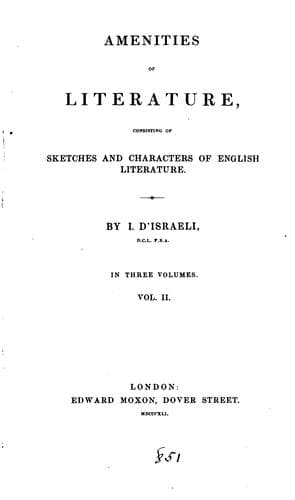
Amenities of Literature: Consisting of Sketches and Characters of English LiteratureDisraeli, Isaac
History
Amenities of Literature: Consisting of Sketches and Characters of English Literature
Disraeli, Isaac
Authors, English -- Biography; English literature -- History and criticism; Great Britain -- Intellectual life
A new species of literature arose in the progress of that practical
education which society had assumed; a literature addressed to the
passions which rose out of the circumstances of the times; dedicated to
war, to love, and to religion, when the business of life seemed
restricted to the extreme indulgence of those ennobling pursuits. In too
much love, too much war, too much devotion, it was not imagined that
knights and ladies could ever err. If sometimes the loves were utterly
licentious, wondrous tales are told of their immaculate purity; if their
religion were then darkened by the grossest superstition, their faith
was genuine, and would have endured martyrdom; and if the chivalric
valour often exulted in its ferocity and its rapacity, its generous
honour amid a lawless state of society maintained justice in the land,
by the lance which struck the oppressor, and by the shield which covered
the helpless.
Everything had assumed a more extended form: the pageantry of society
had varied and multiplied; the banquet was prolonged; the festival day
was frequent; the ballad narrative, or the spontaneous lyric, which had
sufficed their ruder ancestors to allure attention, now demanded more
volume and more variety; the romance with a deeper interest was to
revolve in the entangling narrative of many thousand lines. There was a
traditional store, a stock of fabling in hand, heroical panegyrics,
satirical songs, and legendary ballads; all served as the stuff for the
looms of mightier weavers of rhyme, whose predecessors had left them
this inheritance. The marvellous of Romance burst forth, and this
stupendous fabric of invention bewitched Europe during three centuries.
ROMANCE, from the light fabliau to the voluminous fiction, has admitted,
in the luxury of our knowledge and curiosity, not only of critical
investigation, but of its invention, by tracing it to a single source.
The origin of Romance has been made to hinge on a theoretical history;
and by maintaining exclusive systems, mostly fanciful and partly true,
it has been made complicate. Whether invention in the form of ROMANCE
came from the oriental tale-teller or the Scandinavian Scald, or whether
the fictions of Europe be the growth of the Provençal or the Armorican
soil, our learned inquirers have each told; nor have they failed in
considerably diminishing the claims of each particular system opposed to
their own; but the greatest error will be found in their mutual
refutations.[1] While each stood entrenched in an exclusive system, they
were only furnishing an integral portion of a boundless and complicate
inquiry. They scrutinised with microscopic eyes into that vast fabric of
invention, which the Gothic genius may proudly oppose to the fictions of
antiquity, and they seemed at times forgetful of the vicissitudes which,
at distant intervals, and by novel circumstances, enlarged and modified
the changeful state of romantic fiction among every people.
Public-domain text, read in full here on John Shaqi.
Reviews
Reviews
No reviews yet
Be the first to share your thoughts on this work.
Elsewhere in the archive
Join the Discussion
Join the discussion
Sign in to leave a comment or review.
Sign InorCreate an account