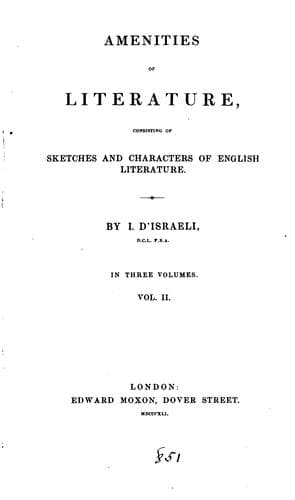
Amenities of Literature: Consisting of Sketches and Characters of English LiteratureDisraeli, Isaac
History
Amenities of Literature: Consisting of Sketches and Characters of English Literature
Disraeli, Isaac
Authors, English -- Biography; English literature -- History and criticism; Great Britain -- Intellectual life
But all the inventions and fashions of man have their date and their
termination. For three centuries these ancient romances, metrical or
prose, had formed the reading of the few who read, and entranced the
circle of eager listeners. The enchantment was on the wane; their
admirers had become somewhat sceptical of "the true history" which had
been so solemnly warranted; another taste in the more chastened
writings of Roman and Grecian lore was now on the ascendant. One last
effort was made in this decline of romantic literature, in that
tesselated compilement where the mottled pieces drawn out of the French
prose romances of chivalry were finely squared together by no unskilful
workman, in Sir THOMAS MALORY, to the English lover of ancient romance
well known by the title of _La Morte d'Arthur_. This last of these
ancient romances was finished in the ninth year of the reign of Edward
IV., about 1470. CAXTON exulted to print this epical romance; and at the
same time he had the satisfaction of reproaching the "laggard" age.
"What do ye now," exclaimed the ancient printer, "but go to the
_Bagnes_, and play at dice? Leave this! leave it! and read these noble
volumes." Volumes which not many years after, when a new system of
affairs had occurred to supplant this long-idolised "order of chivalry,"
ROGER ASCHAM plainly asserted only taught "open manslaughter and bold
bawdry." Such was the final fate of Love and Arms!
FOOTNOTES:
[1] Warton and Percy, Ritson and Leyden, Ellis and Turner and Price,
and recently the late Abbé de la Rue.
[2] A profound and poetic genius has thrown out a new suggestion on
the origin of these Eastern tales. "I think it not unlikely that the
'Milesian Tales' contained the germs of many of those _now in the_
'Arabian Nights.' The Greek empire must have left deep impressions on
the Persian intellect--so also many of the Roman Catholic _Legends_
are taken from _Apuleius_. The exquisite story of Cupid and Psyche is
evidently a philosophical attempt to parry Christianity with a quasi
Platonic account of the fall and redemption of man."--Coleridge's
"Literary Remains," i. 180. Whatever were these "Milesian Tales,"
they amused the Grecian sages in the earliest period of their
history.
[3] Ritson and Weber have elegantly printed some of the best English
metrical romances. In France they have recently enriched literature
with many of these manuscript romances. See "Gentleman's Magazine,"
Oct. 1839.
[4] It is a curious fact, that in 1390 Sir James Douglas, of
Dalkeith, the ancestor of the Earl of Morton, apparently valued them
as about equal to the statutes of the realm; for he bequeathed in his
will to his son, "Omnes libros meos tam _Statutorum_ Regni Scocie
quam _Romancie_."--Laing's "Early Metrical Tales," Edinburgh, 1826.
Public-domain text, read in full here on John Shaqi.
Reviews
Reviews
No reviews yet
Be the first to share your thoughts on this work.
Elsewhere in the archive
Join the Discussion
Join the discussion
Sign in to leave a comment or review.
Sign InorCreate an account