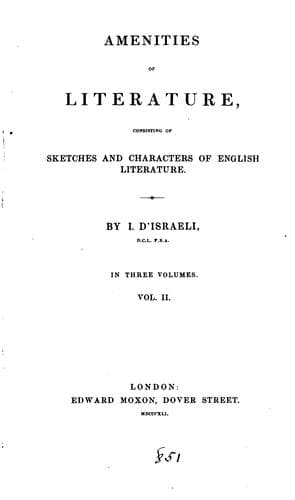
Amenities of Literature: Consisting of Sketches and Characters of English LiteratureDisraeli, Isaac
History
Amenities of Literature: Consisting of Sketches and Characters of English Literature
Disraeli, Isaac
Authors, English -- Biography; English literature -- History and criticism; Great Britain -- Intellectual life
A remarkable instance of the gross impropriety of composing an English
history in Latin, and of the obstinate prejudice of the learned, who
imagined that the ancient idiom conferred dignity on a theme wholly
vernacular, appeared when the delegates of Oxford purchased ANTHONY
WOOD'S elaborate work on "The History and Antiquities of the University
of Oxford." Our honest antiquary, with a true vernacular feeling, had
written the history of an English university, during an uninterrupted
labour of ten years, in his artless but natural idiom. The learned
delegates opined that it was humiliating the Oxford press, to have its
history pass through it in the language of the country; and Dr. Fell,
with others, was chosen to dignify it into Latin. What was the result of
this pompous and inane labour? The author was sorely hurt at the sight
of his fair offspring disguised in its foreign and fantastic dress. What
was clear in English, was obscure in the circumlocution of rotund
periods and affected phraseologies; the circumstantial narrative and the
local descriptions, so interesting to an English reader, were not only
superfluous, but repulsive to the foreigner. ANTHONY WOOD indignantly
re-transcribed the whole of his English copy, and left the fair volumes
to the care of the university itself, not without the hope which has
been realized, that his work should be delivered to posterity stamped by
its author's native genius.[7]
Such was the crisis, and such the difficulties and the obstructions of
that native literature in whose prosperous state every European people
now exults. Homogeneous with their habitual associations, moulded by
their customs and manners, and everywhere stamped by the peculiar
organization of each distinct race, we see the vernacular literature
ever imbued with the qualities of the soil whence it springs,
diversified, yet ever true to nature. Had the native genius of the great
luminaries of literature not found a vein which could reach to the
humblest of their compatriots, they who are now the creators of our
vernacular literature had remained but pompous plagiarists or frigid
babblers, and the moderns might still have been pacing in the trammels
of a mimetic antiquity.
FOOTNOTES:
[1] Sidonius Apollinaris.
[2] An ingenious literary antiquary has given us a copious
vocabulary, as complete evidence of Latin words merely abbreviated by
omitting their terminations, whence originated those numerous
monosyllables which impoverish the French language. In the following
instances the Gauls only used the first syllable for the entire word,
damnum--_damn_; aureum--_or_; malum--_mal_; nudum--_nud_;
amicus--_ami_: vinum--_vin_; homo--_hom_, as anciently written;
curtus--_court_; sonus--_son_; bonus--_bon_: and thus made many
others.
Public-domain text, read in full here on John Shaqi.
Reviews
Reviews
No reviews yet
Be the first to share your thoughts on this work.
Elsewhere in the archive
Join the Discussion
Join the discussion
Sign in to leave a comment or review.
Sign InorCreate an account