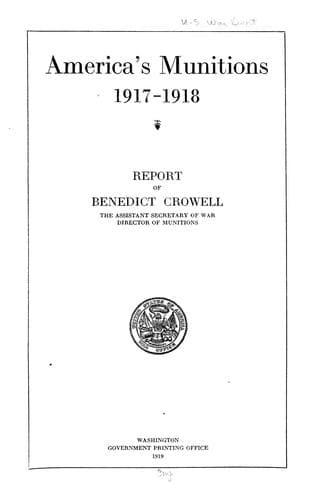
America's Munitions 1917-1918United States. War Department
History
America's Munitions 1917-1918
United States. War Department
United States. Army -- Supplies and stores; Weapons; World War, 1914-1918 -- United States -- Equipment and supplies
In all, 53 new plants for making explosives and propellants and for
loading these were undertaken at a cost of approximately $360,000,000.
When the armistice was signed a very large part of this construction
work had been completed and was in an efficient state of operation.
How creditably this reflects upon America can be understood when it is
made plain that in addition to the development of production there was
also to be worked out the very intricate question of design, not only
of the plants themselves but also of their products, which required an
exceptional degree of technical skill and thorough control.
Prior to our entry into the war the Ordnance Department had depended
upon ammonium picrate, known in the Army vernacular as explosive "D,"
as a bursting charge for our high-explosive shell.
During the progress of the European conflict the British had
developed an explosive they called amatol, which is a mixture of
trinitrotoluol--T. N. T.--and ammonium nitrate. As this had proved to
be entirely satisfactory in actual service on European battle fields,
and as ammonium nitrate could be produced here in large quantities, we
adopted it.
The Ordnance Department eventually put into effect a standard policy
for the use of high explosives. Every effort was being made to conserve
the supply of T. N. T., and consequently this explosive was specified
for the shell of smaller calibers only. The standard filling scheme
was as follows: T. N. T. for shell between and including the calibers
of 75-millimeter and 4.7-inch; amatol for shell of calibers between
4.7-inch and 9.2-inch, including the latter; ammonium picrate, or
explosive D, for shell of 10-inch caliber and higher. While these were
the standards the scheme was not always followed rigidly. As a matter
of fact amatol was loaded into shell of all sizes and so was T. N. T.,
although explosive D was never used in shell smaller than those for the
10-inch guns. These departures from standard practice were due to the
necessity for keeping certain plants in production and to other special
causes and exceptional circumstances.
Production of large quantities of T. N. T. and ammonium nitrate was
the first big problem to be solved by the high-explosives section of
the Ordnance Department. All the work of the explosives section can be
subdivided under four group heads--raw materials, propellants, high
explosives, and loading.
RAW MATERIALS.
The first steps taken in the endeavor to meet the need for raw
materials were to increase greatly the available means for obtaining
toluol, phenol, caustic soda, sodium nitrate, sulphuric and nitric
acids, ammonia liquor or aqua ammonia, and to attempt to provide a
substitute for cellulose in case a shortage of cotton should render its
use necessary.
Public-domain text, read in full here on John Shaqi.
Reviews
Reviews
No reviews yet
Be the first to share your thoughts on this work.
Elsewhere in the archive
Join the Discussion
Join the discussion
Sign in to leave a comment or review.
Sign InorCreate an account