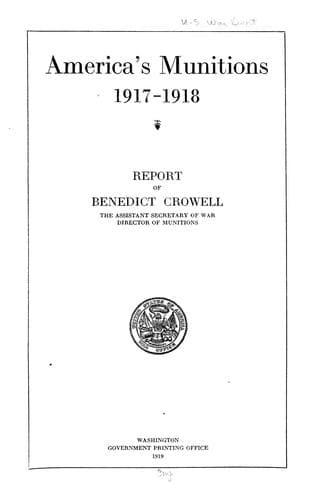
America's Munitions 1917-1918United States. War Department
History
America's Munitions 1917-1918
United States. War Department
United States. Army -- Supplies and stores; Weapons; World War, 1914-1918 -- United States -- Equipment and supplies
| |
-----------------------+------------+--------------------------------
The limiting factor in the development of light field guns has
always been the continuous hauling power of 6 horses, which is
about 4,000 pounds. The gun has been as powerful as possible
within the limits of this weight, which includes the carriage
and limber as well as the cannon itself. Improved technique and
materials have reduced the necessary weight of the cannon from
1,650 pounds in 1815 to about 800 pounds to-day, permitting the
use of weight for recoil mechanism and shield of armor plate
without exceeding the limit.
The 800-pound nickel-steel gun of 1918 fires as heavy a
projectile (12-15 pounds) as the 1,650-pound bronze gun of the
Napoleonic wars. The improved material permits a more powerful
propellant charge, which results in greater muzzle velocity,
a flatter trajectory, and longer maximum range. The latter is
due in part also to improved shapes of projectiles and the
introduction of rifling. The efficiency of artillery is further
increased by the introduction of high-explosive bursting
charge. The modern 75-millimeter shell contains about 1.76
pounds of high explosive as against about 0.5 pound of black
powder in shell prior to 1893.]
The French were experimenting with streamline shell. We adopted the
French streamline 75-millimeter shell and put it into production,
calling it our Mark IV shell. Our regular 75-millimeter shell, known
as the Mark I 1900 shell, had a maximum range of 9,000 yards. The
Mark IV shell proved to have a maximum range of 12,130 yards, giving
an increase in range of well over a mile. America up to April 3, 1919,
turned out about 524,000 of these streamline shell.
The French also built shell of semisteel, steel to which iron was
added. It was claimed that these shell, by bursting into fine fragments
upon exploding, were more effective against troops than all-steel
shell, because the fragments of the latter were larger. We adopted
this shell also and produced it experimentally. In contour it was a
compromise between the old cylindrical shell and the extreme streamline
type and was easier to make than the latter.
_Artillery ammunition, complete rounds--Acceptances in United
States and Canada on U. S. Army orders only._
[Figures in thousands of rounds.]
Public-domain text, read in full here on John Shaqi.
Reviews
Reviews
No reviews yet
Be the first to share your thoughts on this work.
Elsewhere in the archive
Join the Discussion
Join the discussion
Sign in to leave a comment or review.
Sign InorCreate an account