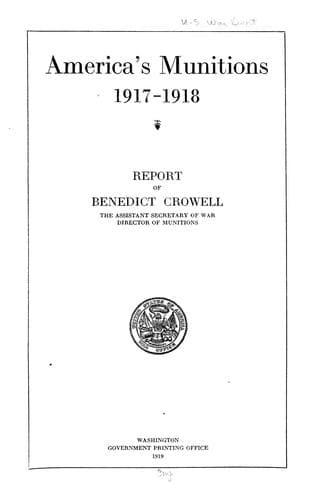
America's Munitions 1917-1918United States. War Department
History
America's Munitions 1917-1918
United States. War Department
United States. Army -- Supplies and stores; Weapons; World War, 1914-1918 -- United States -- Equipment and supplies
Standardization not only made possible the ultimate speed with which
our rifles were produced but, together with the care of the Government
in purchasing raw materials and in drawing contracts, it saved a great
deal of money in the cost of these weapons. The British had been paying
approximately $42 apiece for Enfields produced in the United States.
The modified Enfields cost the Government approximately $26 each.
Thus in the total production of 2,202,429 modified Enfields, we saved
$37,441,293 compared with what this weapon had cost in the past.
Both the Springfield and the 1917 Enfield rifle possessed advantages
of accuracy and speed of fire over the German Mauser. It is true that
the Mauser fired a heavier bullet than that of our standard ammunition
and sent it with somewhat greater velocity; but at the longer
fighting ranges the Mauser bullet is not so accurate as the United
States bullet. Due to its peculiar shape, the Mauser bullet is apt to
tumble end over end at long ranges--"key-holing," the marksmen call
it--particularly when the wind blows across the range. Such tumbling
causes a bullet to curve as a baseball thrown by a good pitcher,
destroying its accuracy.
Early in our fighting with Germany we captured Mauser rifles and
hastened to compare them with the Springfields and modified Enfields.
We found in the American rifles a marked superiority in the rapidity
of fire, the quickness and ease of sighting, and in the accuracy of
shots fired. The accuracy was due not only to our standard Springfield
ammunition, but also to the greater mechanical accuracy in the finish
of the chamber and bore of the American rifles. The rapidity of fire
of the American guns was due to the position and shape of the bolt
handle, which is the movable mechanism on the rifle with which the
soldier ejects a spent shell and throws in a fresh one.
How we developed this bolt handle is an interesting story in itself. In
1903, when we brought out the first Springfield rifle, we decided to
abandon the old carbine which had been carried by our Cavalry regiments
and, by making a rifle with a comparatively short barrel, furnish a
gun which could be used by both Infantry and Cavalry. The original
bolt handle of the Springfield, like the one on the present Mauser,
had projected horizontally from the side of the chamber. It was found
that this protuberance did not fit well in the saddle holster of the
cavalryman, but jammed the side of the rifle against the leather of
the holster, with frequent injury to the rifle sight. For this primary
reason the rifle designers bent the bolt handle down and back. This
modification incidentally brought the bolt handle much nearer to the
soldier's hand as he fingered the trigger than it had been before. The
Enfield design had carried this development even farther, so that the
bolt handle was practically right at the trigger, and the rifleman's
hand was ready to pull the trigger the instant after it had thrown in a
new cartridge.
Public-domain text, read in full here on John Shaqi.
Reviews
Reviews
No reviews yet
Be the first to share your thoughts on this work.
Elsewhere in the archive
Join the Discussion
Join the discussion
Sign in to leave a comment or review.
Sign InorCreate an account