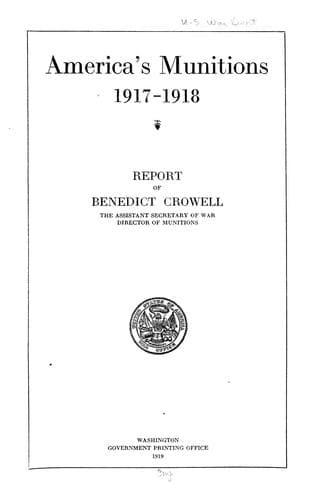
America's Munitions 1917-1918United States. War Department
History
America's Munitions 1917-1918
United States. War Department
United States. Army -- Supplies and stores; Weapons; World War, 1914-1918 -- United States -- Equipment and supplies
Only a few men of each infantry regiment carried pistols when our
troops first went into the trenches. But in almost the first skirmish
this weapon proved its superior usefulness in trench fighting. Such
incidents as that of the single American soldier who dispersed or
killed a whole squad of German bayoneteers which had surrounded him
struck the enemy with fear of Yankee prowess with the pistol. The
"tenderfoot's gun," as the westerners loved to call it, had come to its
own.
By midsummer of 1917 the decision had been made to supply to the
infantry a much more extensive equipment of automatic pistols than had
previously been prescribed by regulations--to build them by hundreds of
thousands where we had been turning them out by thousands. In February,
with war in sight, realizing the limitations of our capacity then for
producing pistols, the Colt automatic being manufactured exclusively by
the Colt's Patent Firearms Manufacturing Co. at Hartford, Conn., and
for a limited period by the Springfield Armory, we took up with the
Colt Co. the proposition of securing drawings and other engineering
data which would enable us to extend the production of this weapon to
other plants. This work was in progress when in April, 1917, it was
interrupted by the military necessity for calling upon every energy we
had in the production of rifles.
In order to supplement the pistol supply, although the Colt automatic
was the only weapon of this sort approved for the Army, the Secretary
of War authorized the Chief of Ordnance to secure other small arms,
particularly the double-action .45-caliber revolver as manufactured by
both the Colt Co. and the Smith & Wesson Co. These revolvers had been
designed to use the standard Army caliber-.45 pistol cartridges. The
revolver was not so effective a weapon as the automatic pistol, but
it was adopted in the emergency only to make it possible to provide
sufficient of these arms for the troops at the outset.
At the start of hostilities the Colt Co. indicated that it could tool
up to produce pistols at the rate of 6,000 per month by December, 1917,
and could also furnish 600 revolvers a week beginning in April. As soon
as funds were available we let a contract to the Colt Co. for 500,000
pistols and 100,000 revolvers, and to the Smith & Wesson Co. one for
100,000 revolvers. Although these contracts were not placed until
June 15, in the certainty that funds would eventually be available
both concerns had been working on the production of weapons on these
expected contracts for many weeks.
Public-domain text, read in full here on John Shaqi.
Reviews
Reviews
No reviews yet
Be the first to share your thoughts on this work.
Elsewhere in the archive
Join the Discussion
Join the discussion
Sign in to leave a comment or review.
Sign InorCreate an account