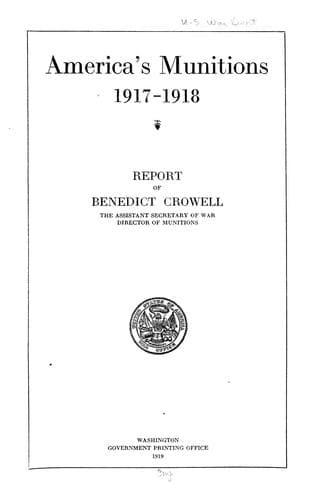
America's Munitions 1917-1918United States. War Department
History
America's Munitions 1917-1918
United States. War Department
United States. Army -- Supplies and stores; Weapons; World War, 1914-1918 -- United States -- Equipment and supplies
One of the first acts of the Ordnance Department was to send an officer
to visit the ammunition factories of France and England to study
the methods of manufacturing these special types of bullets. These
friendly nations willingly gave us full information at first hand with
respect to this complicated manufacture, which we were thus enabled to
begin in September, 1917. Special machinery was required for loading
the tracer bullet and also for producing the incendiary projectile.
We adopted British practice for both of these. We ourselves were well
equipped to begin the production of armor-piercing bullets, for which
we had previously solved the problems of design; yet the production of
metals to be used in this missile required some further experimental
work. By February, 1918, however, our production of armor-piercing
bullets was well under way and by the time the war came to an end we
had produced nearly 5,000,000 of them.
The tracer bullet which we manufactured contained a mixture of barium
peroxide and magnesium and in flight burned with the intensity of
a calcium light. These bullets were principally used by machine
gunners of aircraft, since in the air it is impossible to tell where
machine-gun projectiles are going unless there is some device enabling
the gunner to see the trajectory of the bullets. This is done by
inserting tracer bullets at intervals in the belts of cartridges fed
into the machine gun. The common conception of a tracer bullet is one
that leaves a trace of smoke in its flight; whereas the truth is that
our tracer and the British tracer were practically smokeless, the
gunner observing the direction of aim by following the bright lights
of the tracer bullets with his eye. These lights were plainly visible
in the brightest sunlight. Although the slight quantity of the flaming
mixture burned but a few seconds, it was sufficient to trace the flight
for 500 yards or more from the muzzle of the machine gun.
The tracer bullet consisted of a cupronickel shell, the nose of which
contained a leaden core to balance the bullet properly. The rear
chamber of the bullet held a cup containing the mixture of barium
peroxide and magnesium. The rear end of the bullet was left slightly
open, and through this opening the mixture was ignited by the hot flame
of the propelling powder discharge.
Public-domain text, read in full here on John Shaqi.
Reviews
Reviews
No reviews yet
Be the first to share your thoughts on this work.
Elsewhere in the archive
Join the Discussion
Join the discussion
Sign in to leave a comment or review.
Sign InorCreate an account