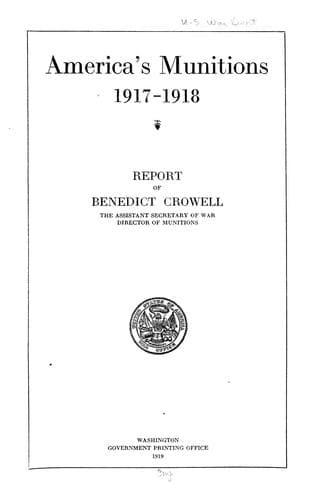
America's Munitions 1917-1918United States. War Department
History
America's Munitions 1917-1918
United States. War Department
United States. Army -- Supplies and stores; Weapons; World War, 1914-1918 -- United States -- Equipment and supplies
The original contract for rifle grenades had been let to the
Westinghouse Electric & Manufacturing Co. of Pittsburgh. This called
for the production of all parts by the Westinghouse Co. and the
assembling of them in the Westinghouse plant to the number of 5,000,000
grenades. But there was such a diversity of material employed in the
manufacture of rifle grenades that succeeding contracts were let for
parts and for assembling separately.
After the rifle grenade had been redesigned new contracts were let
for a total of 30,115,409 of them. In August, a few weeks later, the
daily production of these grenades in the various plants had reached
a total of 130,000 and by the end of October the daily production was
250,000. The goal toward which this production was aiming was the
expected spring offensive of the American Expeditionary Forces in 1919.
We should have met this event adequately because, while only 685,200
American rifle grenades had actually been shipped overseas when the
fighting ceased, we had 20,000,000 of them ready for loading at that
time and the production was already heavy and constantly increasing.
Special consideration is due the following-named firms for their
efforts in developing the production of rifle grenades:
Westinghouse Electric & Manufacturing Co., Pittsburgh, Pa.
Briggs & Stratton Co., Milwaukee, Wis.
Holcomb & Hoke, Indianapolis, Ind.
Stewart-Warner Speedometer Corporation, Chicago, Ill.
Cutler-Hammer Manufacturing Co., Milwaukee, Wis.
American Radiator Co., Buffalo, N. Y.
Link-Belt Co., Indianapolis, Ind.
Doehler Die Castings Co., Brooklyn, N. Y.
TOXIC GAS EQUIPMENT.
America entered the war nearly two years after the Germans had made
their first gas attack. In those intervening months gas warfare had
grown to be a science in itself, requiring special organizations with
each army to handle it.
The employment of toxic gas had developed along several lines. The
original attack by the Germans upon the mask-less Canadians at Ypres
had been in the form of a gas cloud from projectors, these latter being
pressure tanks with nozzle outlets. For some time the Germans continued
the use of gas solely by this method. Retaliation on the part of the
allies quickly followed. However, the employment of gas cloud attacks
involved great labor of preparation and was absolutely dependent
upon certain combinations of weather conditions. In consequence, the
launching of a gas attack in this form could not be timed with regard
to other tactical operations. Therefore the allies were put to the
necessity of developing other means of throwing toxic gases, and this
they did by inclosing the gas in shell shot from the big guns of the
artillery, in grenades thrown by hand from the trenches, and--most
effectively of all--by the agency of an ingenious invention of the
British known as the Livens projector.
Public-domain text, read in full here on John Shaqi.
Reviews
Reviews
No reviews yet
Be the first to share your thoughts on this work.
Elsewhere in the archive
Join the Discussion
Join the discussion
Sign in to leave a comment or review.
Sign InorCreate an account