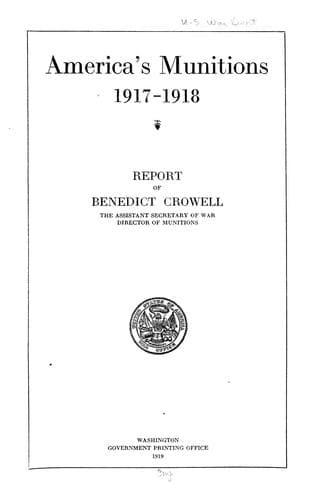
America's Munitions 1917-1918United States. War Department
History
America's Munitions 1917-1918
United States. War Department
United States. Army -- Supplies and stores; Weapons; World War, 1914-1918 -- United States -- Equipment and supplies
The Ensign-Bickford Co., of Simsbury, Conn., produced 334,300 fuses for
Livens shell; the Artillery Fuse Co., of Wilmington, Del., assembled
26,000 firing mechanisms; the E. I. du Pont Co., at its Pompton Lakes
(N. J.) plant, manufactured 20,000 detonators, and 487,350 detonators
were produced by the Aetna Explosives Co., at Port Ewan, N. Y.; while
the American Can Co., at Lowell, Mass., assembled 256,231 firing
mechanisms.
Shear wire pistols were used in the operation of the Livens projector.
The Edison Phonograph Co., of Orange, N. J., produced 181,900 of these,
and the Artillery Fuse Co., of Wilmington, Del., 11,747. The adapters
and boosters of the shell were all built by the John Thompson Press, of
New York. The Waterbury Brass Goods Co., of Waterbury, Conn., made the
fuse casing. Adapters and boosters to the number of 334,500 were turned
out by the former, and 299,900 fuse casings by the latter.
The manufacture of gas drums for the projectors was delayed for some
time because of difficulties in welding certain parts of the drums.
Acetylene and arc welding processes were tried out, and a good many
shell were made by such welding; but the lack of expert welders for
these processes, and the rejections of shell due to leakage in the
welded joints, caused the manufacturer to turn to fire welding, the
process for which had been developed by the Air-tight Steel Tank Co.,
of Pittsburgh, Pa. At the time the armistice was signed the welding
problem had been overcome and the production was going forward at a
rate to meet the requirements of the expected fighting in the spring of
1919. The shell delivered were produced as follows:
By the Federal Pressed Steel Co., of Milwaukee, Wis., 5,609; by the
Pressed Steel Tank Co., also of Milwaukee, 20,536; by the Air-tight
Steel Tank Co., of Pittsburgh, Pa., 600; by the National Tube Co., of
Pittsburgh, 27,098; by the Truscon Steel Co., of Youngstown, Ohio,
19,880. The entire Livens shell program, as it existed in November,
1918, called for the production of 334,000 shell.
TRENCH MORTARS.
The production of trench mortars was not only an important part of our
ordnance program but it was an undertaking absolutely new to American
experience. Not only did we have to produce mortars, but we had to
supply them with shell in great quantities, this latter in itself an
enterprise of no mean proportions.
Public-domain text, read in full here on John Shaqi.
Reviews
Reviews
No reviews yet
Be the first to share your thoughts on this work.
Elsewhere in the archive
Join the Discussion
Join the discussion
Sign in to leave a comment or review.
Sign InorCreate an account