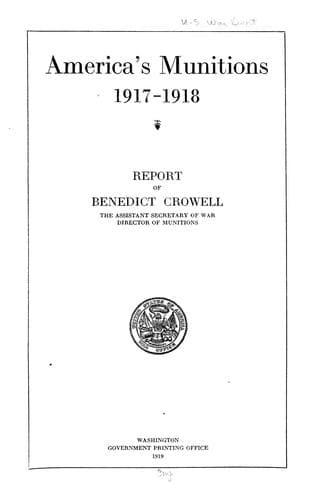
America's Munitions 1917-1918United States. War Department
History
America's Munitions 1917-1918
United States. War Department
United States. Army -- Supplies and stores; Weapons; World War, 1914-1918 -- United States -- Equipment and supplies
Yet it never completely disappeared in warfare. Gen. Rochambeau is said
to have worn body armor at the siege of Yorktown. Great numbers of
corselets and headpieces were worn in the Napoleonic wars. The corselet
which John Paul Jones wore in his fight with the Serapis is preserved
at the Metropolitan Museum of Art in New York. The Japanese army was
mailed with good armor as late as 1870. Breastplates were worn to some
extent in the Civil War in the United States, and an armor factory was
actually established at New Haven, Conn., about 1862. In the museum
at Richmond, Va., is an equipment of armor taken from a dead soldier
in one of the trenches at the siege of that city. There was a limited
use of armor in the Franco-Prussian War. Some of the Japanese troops
carried shields at Port Arthur. Helmets were worn in the Boer War. A
notorious Australian bandit in the eighties for a long time defied
armed posses to capture him because he wore armor and could stand off
entire squads of policemen firing at him with Martini rifles at close
range.
Thus it can not be said that armor, in coming into use again in the
great war, was resurrected; it was merely revived. In its static
condition during most of the four-year period, the war against Germany
was one in which armor might profitably be used. This opportunity could
scarcely be overlooked, and indeed it was not. Everybody knows of the
helmets that were in general use; yet body armor itself was coming into
favor again, and only the welcome but unexpected end of hostilities
prevented it, in all probability, from becoming again an important part
of the equipment of a soldier.
As a consequence of the attenuated but persistent use of armor by
soldiers during the past two centuries and of the demand of the
aristocratic for helmets and armor as ornaments, the armorer's trade
had been kept alive from the days of Gustavus Adolphus to the present.
The war efforts of the United States in 1917 and 1918 demanded a wide
range of human talents and special callings; but surely the strange and
unusual seemed to be reached when in the early days of our undertaking
the Engineering Division of the Ordnance Department sought the services
of expert armorers.
Through the advice of the National Research Council, which had
established a committee of armor experts, the Ordnance Department
commissioned in its service Maj. Bashford Dean, a life-long specialist
in armor, curator in the Metropolitan Museum of Art, an institution
which, learning of the Government's need, at once placed at its
disposal its wonderful specimens of authentic armor, its armor repair
shop where models could at once be made, and the services of Maj.
Dean's assistant there whom he had brought from France, Daniel Tachaux,
one of the few surviving armorers, who had inherited lineally the
technical side of the ancient craft.
Public-domain text, read in full here on John Shaqi.
Reviews
Reviews
No reviews yet
Be the first to share your thoughts on this work.
Elsewhere in the archive
Join the Discussion
Join the discussion
Sign in to leave a comment or review.
Sign InorCreate an account