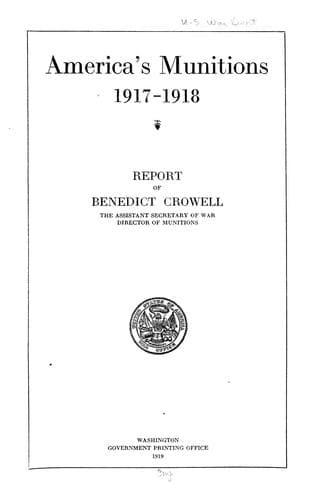
America's Munitions 1917-1918United States. War Department
History
America's Munitions 1917-1918
United States. War Department
United States. Army -- Supplies and stores; Weapons; World War, 1914-1918 -- United States -- Equipment and supplies
We developed a heavy breast plate with thigh guards, weighing 27
pounds, which stopped machine gun bullets at 150 yards. An experimental
lot of these were completed in 26 days by the Mullins Manufacturing
Co., of Salem, Ohio. These were also shipped abroad for test.
A few defenses for arms and legs were prepared which, although light in
weight, would protect the wearer from an automatic-pistol ball at 10
feet. About 70 per cent of the hospital cases in France were casualties
caused by wounds in the arms and legs. These defenses, however, were
rejected on account of their impeding to a certain degree the movements
of the wearer.
Our development in armor also produced an aviator's chair weighing 60
pounds. It would protect the pilot from injury from below and from the
back, withstanding armor-piercing bullets fired at a distance of 50
yards. Since the piercing of the gas mask canister by a bullet might
result in the death of the soldier by admitting gas directly into the
breathing system of his mask, the Ordnance Department designed an
armored haversack for the gas mask and its canister, this haversack
incidentally serving as a breast defense.
BAYONETS AND TRENCH KNIVES.
Another large ordnance operation was the production of bayonets for
the service rifles. The British bayonet had proved to be highly
satisfactory in the war; and, since it was already designed to fit the
Enfield rifle, which we had adopted for our own, we took the British
bayonet as it was and, with only one slight alteration, set out to
produce it in this country.
The Government found both the Remington Arms-Union Metallic Cartridge
Co. at its Bridgeport, Conn., works, and the Winchester Repeating Arms
Co. building these bayonets for the English Government. The latter's
bayonet needs by 1917 were being well supplied by home manufacture,
and this permitted us to buy approximately 545,500 bayonets which had
already been manufactured for the British.
The Ordnance Department at once started out these two concerns on
contracts for bayonets for the American Government, Remington with
total orders for 2,820,803 bayonets and Winchester with orders for
672,500. Remington delivered in all 1,565,644 bayonets and Winchester
395,894. This was a total of 1,961,500 bayonets.
The total production of 1917 rifles was about 2,520,000. These
figures indicate that we were short over 500,000 bayonets at the time
hostilities ceased; and as a matter of fact this shortage had already
become acute, especially in the training camps.
Public-domain text, read in full here on John Shaqi.
Reviews
Reviews
No reviews yet
Be the first to share your thoughts on this work.
Elsewhere in the archive
Join the Discussion
Join the discussion
Sign in to leave a comment or review.
Sign InorCreate an account