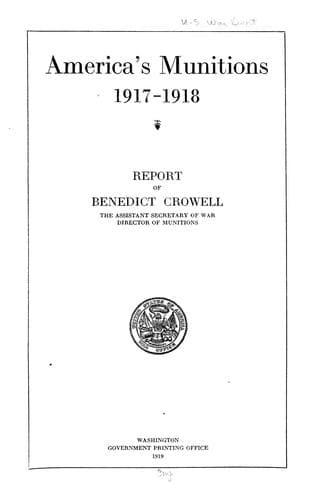
America's Munitions 1917-1918United States. War Department
History
America's Munitions 1917-1918
United States. War Department
United States. Army -- Supplies and stores; Weapons; World War, 1914-1918 -- United States -- Equipment and supplies
Within the Army itself there was small nucleus of skill around which
could be built an organization expert and sophisticated. We had in
the official files no adequate information as to sizes, capacities,
and types of planes or engines, or character of ordnance, armament,
or aeronautical appliances demanded by the exacting service in which
our young birdmen were soon to engage. Even the airplanes on order
in April, 1917 (over 350 of them), proved to be of such antiquated
design that the manufacturers of them, in the light of their increased
knowledge of war requirements a few months later, asked to be released
from their contracts.
Nor was there in the United States any industry so closely allied to
airplane manufacture that its engineers and designers could turn from
one to the other and take their places at once abreast of the progress
in Europe. There was little or no engineering talent in the United
States competent to design fully equipped military aircraft which could
compete with Europe. Our aircraft producers must first go to France
and England and Italy, and ground themselves in the principles of a
new science before they could attempt to produce their own designs
or even before they could be safe in selecting European designs for
reproduction in this country.
The first consideration of the whole program by the Joint Army and
Navy Technical Board indicated a figure of 22,000 as the number of
airplanes, including both training and battle types, which should be
furnished for the use of the Army during the 12 months following July
1, 1917. This figure represented the determination of America to play
a major part in aerial warfare. It was not possible for the board to
realize at that time all of the problems which would be encountered,
and the figures indicated confidence in the ability of the industrial
organizations of the United States to meet a difficult situation,
rather than an exact plan under which such production might be
developed.
It is probable that it was not fully realized that the production of
this program, with the proper proportion of spare parts required for
military operations, meant the manufacture of the equivalent of about
40,000 airplanes.
Without an industry then, and with little knowledge or understanding
of the problems of military aerial equipment, we faced the task
of securing the equivalent of 40,000 airplanes in 12 brief months
beginning July, 1917.
Public-domain text, read in full here on John Shaqi.
Reviews
Reviews
No reviews yet
Be the first to share your thoughts on this work.
Elsewhere in the archive
Join the Discussion
Join the discussion
Sign in to leave a comment or review.
Sign InorCreate an account