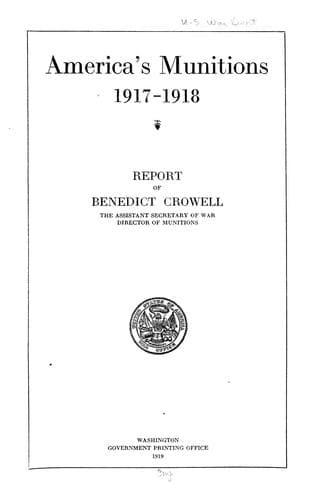
America's Munitions 1917-1918United States. War Department
History
America's Munitions 1917-1918
United States. War Department
United States. Army -- Supplies and stores; Weapons; World War, 1914-1918 -- United States -- Equipment and supplies
Such was the task assigned to an industry that in the previous 12
months had manufactured less than 800 airplanes, and those consisting
principally of training planes for foreign governments.
The expanding national ambition for an aircraft industry was also shown
by the mounting money grants. On May 12 Congress voted $10,800,000 for
military aeronautics. On June 15 an appropriation of $43,450,000 was
voted for the same purpose. Finally on July 24, 1917, the President
signed the bill appropriating $640,000,000 for aircraft. This was the
largest appropriation ever made by Congress for one specific purpose,
and this bill was put through both Houses within the period of a little
more than a week.
The figure 22,000, however, scarcely indicates the size of this
undertaking, as we were to realize before long. We little understood
the infinite complications of fully equipping battle planes. Lacking
that invaluable experience which Europe had attained in three years of
production, we had no practical realization of the fact that for each
100 airplanes an equivalent of 80 additional airplanes must be provided
in spare parts. In other words, an effective fighting plane delivered
in France is not one plane, but it is one plane and eight-tenths of
another; which means that the program adopted in June, 1917, called
for the production in 12 months of not 22,000 airplanes but rather the
equivalent of 40,000 airplanes.
Let us set down the inventory of the Government's own resources for
handling this project.
The American Air Service, which was then part of the Signal Corps, had
had a struggling and meager existence, working with the old pusher
type of planes until in 1914 an appropriation of $250,000 was made
available for the purchase of new airplanes and equipment. Shortly
after this appropriation was granted, five officers were sent to the
Massachusetts Institute of Technology for a course in aeronautics. When
the war broke out in Europe in August, 1914, these men constituted the
entire technically trained personnel of the Air Service of the United
States. By April 6, 1917, we had 65 officers in the Air Service, an
enlisted and civilian personnel of 1,330, two flying fields, and a few
serviceable planes of the training type.
This equipment may be compared with that of Germany, France, and
England at the time they went to war. Germany is believed to have had
nearly 1,000 airplanes in August, 1914; France had about 300; and
England barely 250. America's 224, delivered up to April 6, 1917, were
nearly all obsolete in type when compared with the machines then in
effective service in France.
Public-domain text, read in full here on John Shaqi.
Reviews
Reviews
No reviews yet
Be the first to share your thoughts on this work.
Elsewhere in the archive
Join the Discussion
Join the discussion
Sign in to leave a comment or review.
Sign InorCreate an account