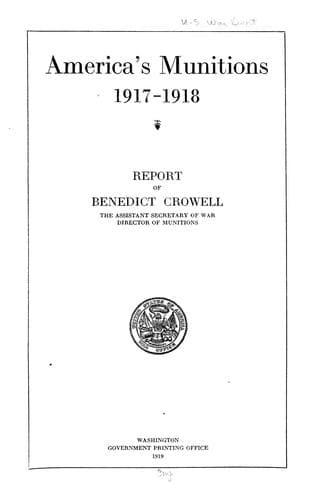
America's Munitions 1917-1918United States. War Department
History
America's Munitions 1917-1918
United States. War Department
United States. Army -- Supplies and stores; Weapons; World War, 1914-1918 -- United States -- Equipment and supplies
The flying surfaces of an airplane are made by stretching cloth over
the frames. When we came into war it was supposed that linen was the
only common fabric with sufficient strength for this use, and linen
was almost exclusively used by the airplane builders, although Italian
manufacturers were trying to develop a cotton fabric. Of the three
principal sources of flax, Belgium had been cut off from the allies,
Russia was isolated entirely after the revolution there, and Ireland
was left as the sole available land from which flax for airplane linen
could be obtained.
As late as August, 1917, England assured us that she could supply all
of the linen that would be needed. It rapidly became evident that
England had underestimated our requirements. An average airplane
requires 250 yards of fabric, while some of the large machines
need more than 500 yards. And these requirements do not take into
consideration the spare wings which must be supplied with each
airplane. This meant a demand for millions of yards put upon the Irish
supply, which had no such surplus above allied needs.
For some time prior to April 6, 1917, the Bureau of Standards at
Washington had been experimenting with cotton airplane cloths. Out of
the large variety of fabrics tested several promising experimental
cloths were produced. The chief objection to cotton was that the dope
which gave satisfactory results on linen failed to work with uniformity
on cotton. Therefore, it became apparent that if we were to use cotton
fabric, we should have to invent a new dope.
Two grades of cotton airplane cloth were finally evolved--A, which
had a minimum strength of 80 pounds per inch, and B, with a minimum
strength of 75 pounds per inch. Grade A was later universally adopted.
This cloth weighed four and one-half ounces per square yard.
We placed our first orders for cotton airplane fabric in September,
1917--orders for 20,000 yards--and from that time on the use of linen
decreased. By March of 1918 the production of cotton airplane cloth
had reached 400,000 yards per month. In May the production was about
900,000 yards; and when the war ended this material was being turned
out at the rate of 1,200,000 yards per month. Starting with a few
machines, our cotton mills had gradually brought 2,600 looms into the
enterprise, each loom turning out about 120 yards of cloth in a week.
A total of 10,248,355 yards of cotton fabric was woven and delivered
to the Government--over 5,800 miles of it, nearly enough to reach from
California to France. The use of cotton fabric so expanded that in
August, 1918, we discontinued the importations of linen altogether.
Public-domain text, read in full here on John Shaqi.
Reviews
Reviews
No reviews yet
Be the first to share your thoughts on this work.
Elsewhere in the archive
Join the Discussion
Join the discussion
Sign in to leave a comment or review.
Sign InorCreate an account