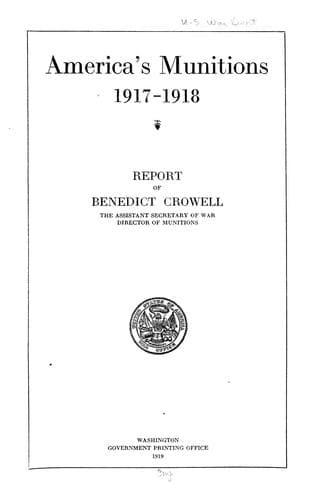
America's Munitions 1917-1918United States. War Department
History
America's Munitions 1917-1918
United States. War Department
United States. Army -- Supplies and stores; Weapons; World War, 1914-1918 -- United States -- Equipment and supplies
| 160| 116| } 19| { 116
1916 |{Watervliet Arsenal | 264| 161| }| { 192
|{Bethlehem Steel Co. | 340| 2| }| { 2
| | | | |
75-mm. cannon (French) |{Symington-Anderson Co. | 4,300| 103| | 860
|{Wisconsin Gun Co. | 2,050| 9| | 190
| | | | |
75-mm. cannon (British) |Bethlehem Steel Co. | 2,868| 592| 124| 909
------------------------+------------------------+------+------+------+------
4.7-INCH GUNS.
In the 4.7-inch field gun, model of 1906, America took to France a
weapon all her own. It was a proven gun, too, developed under searching
experiments and tests. There were 60 of these in actual service when
we got into the war. The 4.7-inch guns, with their greater range and
power, promised to be particularly useful for destroying the enemy's
77-millimeter guns.
The carriage model of 1906 for the 4.7-inch gun is of the long recoil
type, the recoil being 70 inches in length. The recoil is checked by a
hydraulic cylinder, and a system of springs thereupon returns the gun
to the firing position. The gun's maximum elevation is 15 degrees, at
which elevation, with a 60-pound projectile, the gun has a range of
7,260 meters, or 4½ miles. With a 45-pound projectile a range of 8,750
meters, or nearly 5½ miles, can be obtained at 15 degrees elevation.
It is possible to increase this range to about 10,000 meters, or well
over 6 miles, by depressing the trail into a hole prepared for it, a
practice often adopted on the field to obtain greater range. The total
weight of the gun carriage with its limber is about 9,800 pounds.
An order for 250 of the 4.7-inch carriages was placed with the Walter
Scott Co., at Plainfield, N. J., July 12, 1917, upon the recommendation
of committees of the Council of National Defense, who were assisting
the Ordnance Department in the selection of industrial firms willing to
accept artillery contracts. Of the 250 ordered from this concern, 49
were delivered up to the signing of the armistice.
The Rock Island Arsenal had also been employed previously in turning
out 4.7-inch carriages; and the capacity of that plant, although
small, was utilized. Under the date of July 23, 1917, the arsenal
was instructed to deliver 183 carriages. Late in December, 1917,
the Studebaker Corporation was given an order for 500. On September
30, 1918, Rock Island Arsenal was given an additional order for 120
carriages, while the Studebaker order was reduced to 380. Additional
plant facilities had to be provided at both the Walter Scott Co. and
the Studebaker Corporation.
Public-domain text, read in full here on John Shaqi.
Reviews
Reviews
No reviews yet
Be the first to share your thoughts on this work.
Elsewhere in the archive
Join the Discussion
Join the discussion
Sign in to leave a comment or review.
Sign InorCreate an account