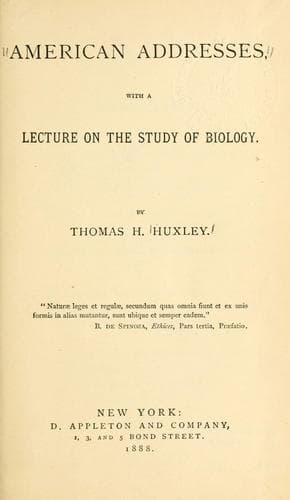
American Addresses, with a Lecture on the Study of BiologyHuxley, Thomas Henry
Science
American Addresses, with a Lecture on the Study of Biology
Huxley, Thomas Henry
Biology -- Study and teaching; Evolution; Johns Hopkins University
Having lightened the medical curriculum by culling out of it everything
which is unessential, we may next consider whether something may not be
done to aid the medical student toward the acquirement of real knowledge
by modifying the system of examination. In England, within my
recollection, it was the practice to require of the medical student
attendance on lectures upon the most diverse topics during three years;
so that it often happened that he would have to listen, in the course of
a day, to four or five lectures upon totally different subjects, in
addition to the hours given to dissection and to hospital practice: and
he was required to keep all the knowledge he could pick up, in this
distracting fashion, at examination point, until, at the end of three
years, he was set down to a table and questioned pell-mell upon all the
different matters with which he had been striving to make acquaintance.
A worse system and one more calculated to obstruct the acquisition of
sound knowledge and to give full play to the "crammer" and the "grinder"
could hardly have been devised by human ingenuity. Of late years great
reforms have taken place. Examinations have been divided so as to
diminish the number of subjects among which the attention has to be
distributed. Practical examination has been largely introduced; but
there still remains, even under the present system, too much of the old
evil inseparable from the contemporaneous pursuit of a multiplicity of
diverse studies.
Proposals have recently been made to get rid of general examinations
altogether, to permit the student to be examined in each subject at the
end of his attendance on the class; and then, in case of the result
being satisfactory, to allow him to have done with it; and I may say
that this method has been pursued for many years in the Royal School of
Mines in London, and has been found to work very well. It allows the
student to concentrate his mind upon what he is about for the time
being, and then to dismiss it. Those who are occupied in intellectual
work, will, I think, agree with me that it is important, not so much to
know a thing, as to have known it, and known it thoroughly. If you have
once known a thing in this way it is easy to renew your knowledge when
you have forgotten it; and when you begin to take the subject up again,
it slides back upon the familiar grooves with great facility.
Lastly comes the question as to how the university may co-operate in
advancing medical education. A medical school is strictly a technical
school--a school in which a practical profession is taught--while a
university ought to be a place in which knowledge is obtained without
direct reference to professional purposes. It is clear, therefore, that
a university and its antecedent, the school, may best co-operate with
the medical school by making due provision for the study of those
branches of knowledge which lie at the foundation of medicine.
Public-domain text, read in full here on John Shaqi.
Reviews
Reviews
No reviews yet
Be the first to share your thoughts on this work.
Elsewhere in the archive
Join the Discussion
Join the discussion
Sign in to leave a comment or review.
Sign InorCreate an account