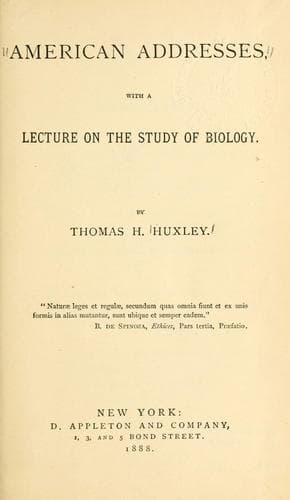
American Addresses, with a Lecture on the Study of BiologyHuxley, Thomas Henry
Science
American Addresses, with a Lecture on the Study of Biology
Huxley, Thomas Henry
Biology -- Study and teaching; Evolution; Johns Hopkins University
Up to this point I have considered only the teaching aspect of your
great foundation, that function of the university in virtue of which it
plays the part of a reservoir of ascertained truth, so far as our
symbols can ever interpret nature. All can learn; all can drink of this
lake. It is given to few to add to the store of knowledge, to strike new
springs of thought, or to shape new forms of beauty. But so sure as it
is that men live not by bread, but by ideas, so sure is it that the
future of the world lies in the hands of those who are able to carry the
interpretation of nature a step further than their predecessors; so
certain is it that the highest function of a university is to seek out
those men, cherish them, and give their ability to serve their kind full
play.
I rejoice to observe that the encouragement of research occupies so
prominent a place in your official documents, and in the wise and
liberal inaugural address of your president. This subject of the
encouragement, or, as it is sometimes called, the endowment of research,
has of late years greatly exercised the minds of men in England. It was
one of the main topics of discussion by the members of the Royal
Commission of whom I was one, and who not long since issued their
report, after five years' labour. Many seem to think that this question
is mainly one of money; that you can go into the market and buy
research, and that supply will follow demand, as in the ordinary course
of commerce. This view does not commend itself to my mind. I know of no
more difficult practical problem than the discovery of a method of
encouraging and supporting the original investigator without opening the
door to nepotism and jobbery. My own conviction is admirably summed up
in the passage of your president's address, "that the best investigators
are usually those who have also the responsibilities of instruction,
gaining thus the incitement of colleagues, the encouragement of pupils,
and the observation of the public."
Public-domain text, read in full here on John Shaqi.
Reviews
Reviews
No reviews yet
Be the first to share your thoughts on this work.
Elsewhere in the archive
Join the Discussion
Join the discussion
Sign in to leave a comment or review.
Sign InorCreate an account