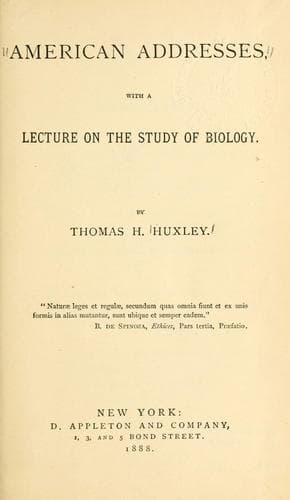
American Addresses, with a Lecture on the Study of BiologyHuxley, Thomas Henry
Science
American Addresses, with a Lecture on the Study of Biology
Huxley, Thomas Henry
Biology -- Study and teaching; Evolution; Johns Hopkins University
At the revival of learning, knowledge was divided into two kinds--the
knowledge of nature and the knowledge of man; for it was the current
idea then (and a great deal of that ancient conception still remains)
that there was a sort of essential antithesis, not to say antagonism,
between nature and man; and that the two had not very much to do with
one another, except that the one was oftentimes exceedingly troublesome
to the other. Though it is one of the salient merits of our great
philosophers of the seventeenth century, that they recognised but one
scientific method, applicable alike to man and to nature, we find this
notion of the existence of a broad distinction between nature and man in
the writings both of Bacon and of Hobbes of Malmesbury; and I have
brought with me that famous work which is now so little known, greatly
as it deserves to be studied, "The Leviathan," in order that I may put
to you in the wonderfully terse and clear language of Thomas Hobbes,
what was his view of the matter. He says:--
"The register of knowledge of fact is called history. Whereof there
be two sorts, one called natural history; which is the history of
such facts or effects of nature as have no dependence on man's
will; such as are the histories of metals, plants, animals,
regions, and the like. The other is civil history; which is the
history of the voluntary actions of men in commonwealths."
So that all history of fact was divided into these two great groups of
natural and of civil history. The Royal Society was in course of
foundation about the time that Hobbes was writing this book, which was
published in 1651; and that Society was termed a "Society for the
Improvement of Natural Knowledge," which was then nearly the same thing
as a "Society for the Improvement of Natural History." As time went on,
and the various branches of human knowledge became more distinctly
developed and separated from one another, it was found that some were
much more susceptible of precise mathematical treatment than others. The
publication of the "Principia" of Newton, which probably gave a greater
stimulus to physical science than any work ever published before, or
which is likely to be published hereafter, showed that precise
mathematical methods were applicable to those branches of science such
as astronomy, and what we now call physics, which occupy a very large
portion of the domain of what the older writers understood by natural
history. And inasmuch as the partly deductive and partly experimental
methods of treatment to which Newton and others subjected these branches
of human knowledge, showed that the phenomena of nature which belonged
to them were susceptible of explanation, and thereby came within the
reach of what was called "philosophy" in those days; so much of this
kind of knowledge as was not included under astronomy came to be spoken
of as "natural philosophy"--a term which Bacon had employed in a much
wider sense.
Public-domain text, read in full here on John Shaqi.
American Addresses, with a Lecture on the Study of Biology — John Shaqi
Reviews
Reviews
No reviews yet
Be the first to share your thoughts on this work.
Elsewhere in the archive
Join the Discussion
Join the discussion
Sign in to leave a comment or review.
Sign InorCreate an account