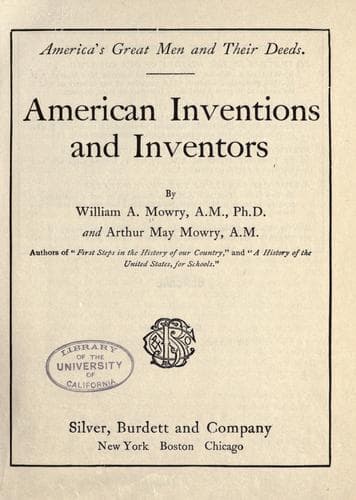
American Inventions and InventorsMowry, William A. (William Augustus)
History
American Inventions and Inventors
Mowry, William A. (William Augustus)
Inventions
"'Lay aside your cloak, O Birch Tree!
Lay aside your white-skin wrapper,
For the Summer-time is coming,
And the sun is warm in heaven,
And you need no white-skin wrapper!'
"With his knife the tree he girdled;
Just beneath its lowest branches,
Just above the roots, he cut it,
Till the sap came oozing outward;
Down the trunk, from top to bottom,
Sheer he cleft the bark asunder,
With a wooden wedge he raised it,
Stripped it from the trunk unbroken.
"'Give me of your boughs, O Cedar!
Of your strong and pliant branches,
My canoe to make more steady,
Make more strong and firm beneath me!'
"Down he hewed the boughs of cedar,
Shaped them straightway to a framework,
Like two bows he formed and shaped them,
Like two bended bows together.
"'Give me of your roots, O Tamarack!
Of your fibrous roots, O Larch Tree!
My canoe to bind together,
So to bind the ends together
That the water may not enter,
That the river may not wet me!'
"From the earth he tore the fibres,
Tore the rough roots of the Larch Tree,
Closely sewed the bark together,
Bound it closely to the framework.
"'Give me of your balm, O Fir Tree.
Of your balsam and your resin,
So to close the seams together
That the water may not enter,
That the river may not wet me!'
"And he took the tears of balsam,
Took the resin of the fir tree,
Smeared therewith each seam and fissure,
Made each crevice safe from water.
"Thus the Birch Canoe was builded
In the valley, by the river,
In the bosom of the forest;
And the forest's life was in it,
All its mystery and its magic,
All the lightness of the birch tree,
All the toughness of the cedar,
All the Larch's supple sinews;
And it floated on the river
Like a yellow leaf in Autumn,
Like a yellow water-lily."
CHAPTER III.
STAGECOACHES.
Both by land and by water the methods of travel among the early
colonists were extremely rude. From the early days of the settlements
until the Independence of the United States the improvement was
very slow. During the seventeenth century practically all of the
long-distance traveling was by water. Schooners made regular trips
from New England to Virginia, and smaller sloops or "packets" ran to
New York from the different towns to the eastward. These vessels were
dependent, of course, upon the wind, and the length of the journey
varied greatly. Perhaps a packet might sail from New Haven to New York
in two days, but calms or contrary winds might delay the trip, and make
it a week in going from port to port.
Public-domain text, read in full here on John Shaqi.
Reviews
Reviews
No reviews yet
Be the first to share your thoughts on this work.
Elsewhere in the archive
Join the Discussion
Join the discussion
Sign in to leave a comment or review.
Sign InorCreate an account