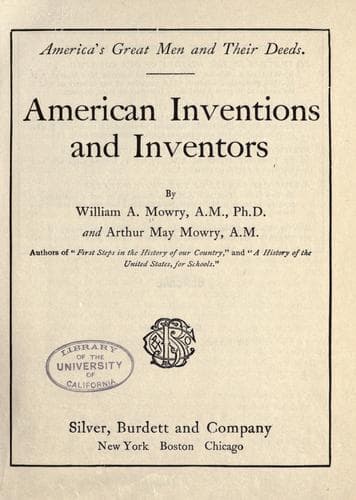
American Inventions and InventorsMowry, William A. (William Augustus)
History
American Inventions and Inventors
Mowry, William A. (William Augustus)
Inventions
The coach would set out from the inn with the horses on a gallop,
which would continue until a steep hill was reached. Then would follow
the slow pacing up the hill, the gallop down again, the dragging
through a stretch of muddy road, the careful fording of a river, the
watering of the horses every few miles, and the rapid gallop up to the
next inn. Here the mail pouches would be taken out and in, perhaps a
change of coaches made or more frequently of horses only, a delay for
a little gossip, and the stage would be off again. This was all very
exhilarating and agreeable in pleasant, warm weather, but how fatiguing
in the cold and snows of winter, and even during a chilly summer storm.
These public conveyances were used only when necessary. Private
carriages were much preferred to the stagecoach, as being a more
comfortable as well as a safer mode of travel. The story is told of
one young lady who was visiting near Boston, eighty years ago. She was
very anxious to return to her home, but her father was unable to come
for her. Her mother wrote: "Your papa would not trust your life in the
stage. It is a very unsafe and improper conveyance for young ladies.
Many have been the accidents, many the cripples made by accidents in
these vehicles. As soon as your papa can, you may be sure he will go or
send for you."
[Illustration: MUNROE TAVERN, LEXINGTON, MASS. (BUILT IN 1695.)]
Whether the traveler went by stage or in his private carriage, it was
necessary to stop at the inns. The taverns had a great deal to do with
making journeys pleasant or disagreeable. As a general rule, the New
England inns were kept by leading men, and in most cases the innkeeper
was required to obtain recommendations from the selectmen of the town
before he could get a license or a permission to establish and keep
the tavern. Even the smaller New England villages boasted of inns that
compared favorably with the hotels of the large towns. A Frenchman,
traveling through the United States early in this century, wrote in
highest praise of the inns of New England, whose windows were without
shutters, and whose doors had neither locks nor keys, and yet where
no harm ever came to the traveler. He admired "the great room, with
its low ceiling and neatly sanded floor; its bright pewter dishes and
stout-backed, slat-bottomed chairs ranged along its walls; its long
table; and its huge fireplace, with the benches on either side."
He had less praise for the inns of the rest of the country. The
buildings were poor, the fare was coarse, and the beds were bad. The
roofs leaked, the windows were sometimes mere openings in the wall; the
bedding was unclean and extremely uninviting.
Public-domain text, read in full here on John Shaqi.
Reviews
Reviews
No reviews yet
Be the first to share your thoughts on this work.
Elsewhere in the archive
Join the Discussion
Join the discussion
Sign in to leave a comment or review.
Sign InorCreate an account