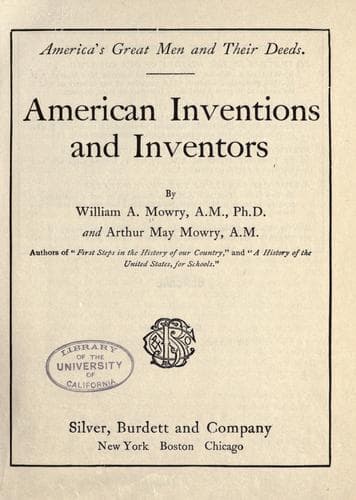
American Inventions and InventorsMowry, William A. (William Augustus)
History
American Inventions and Inventors
Mowry, William A. (William Augustus)
Inventions
Then use was made of the wind, which, blowing against stretches of
canvas, propelled vessels. Here was no human power to become wearied;
no horse power to fail at the wrong time. Vessels need not stop at
night in order to sleep, nor even at noon in order to take dinner. But
the wind is fickle; it does not always blow; it frequently blows from
the wrong direction; it often blows too much. Human power, horse power,
wind power, each was insufficient or unsatisfactory, and the time was
ripe for some power stronger and less fickle to produce more rapid
transportation.
When the necessity of a new power became great, the needed energy and
a way to use it were soon found. Near the close of the eighteenth
century a number of men, unacquainted with each other's ideas, began
to experiment with steam as a means for propelling vessels. Why had
they not begun earlier? For two reasons. The demand for quicker
water travel had but just commenced, and the fact that steam could
practically be used as a motive power was only beginning to be
understood.
It so happened that James Watt's steam engine was perfected just as
the treaty of peace with Great Britain acknowledged the independence
of the United States. Now American inventors were able to make use of
the steam engine to aid travel and transportation. At once they began
work. Samuel Morey built a steamboat on the upper Connecticut River;
James Rumsey experimented on the Potomac; John Fitch on the Delaware,
and William Longstreet on the Savannah; Oliver Evans was at work in
Philadelphia, and John Stevens on the Hudson.
[Illustration: FITCH'S STEAMBOAT.]
One of these boats used the steam engine to move oars; another pumped
water in at the bow and forced it out again at the stern; a third had a
wheel in the stern; and a fourth had a paddle wheel on each side. Some
of the vessels used upright, and some horizontal engines. Most of these
inventors succeeded in running their boats against the tide or the
current of rivers, and proved that steam could be thus used. Each may
be said to have invented a steamboat. But these men were all without
means; they did not succeed in awakening the interest of wealthy men;
and the public cared little about such inventions. Therefore each
of these steamboats was given up in turn and soon forgotten; the
eighteenth century passed away, and no practical result had appeared.
It is natural to have more interest in the account of an invention
which proved of practical value than in the stories of even successful
attempts which were given up almost as soon as made.
Public-domain text, read in full here on John Shaqi.
Reviews
Reviews
No reviews yet
Be the first to share your thoughts on this work.
Elsewhere in the archive
Join the Discussion
Join the discussion
Sign in to leave a comment or review.
Sign InorCreate an account