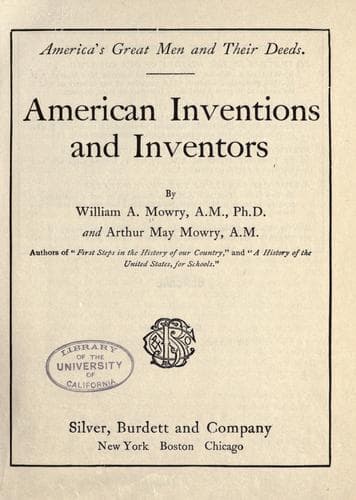
American Inventions and InventorsMowry, William A. (William Augustus)
History
American Inventions and Inventors
Mowry, William A. (William Augustus)
Inventions
Up to this time progress had been more marked upon the water than upon
the land. On the land travelers were still limited to human power and
horse power. On the water, however, not only human power and wind were
used, but also horse power and even steam power. The steamboat was
thought to be the most rapid means of transit possible. No energy was
known greater than that of steam; therefore no new source of power was
expected.
If steam could aid water navigation, could it not be used in land
travel? This question was ever present in the minds of inventors,
mechanics, and travelers on both sides of the ocean. Little by little
an answer was obtained, and the field of steam was enlarged. Even
before Fulton's trial trip, the first step in the direction of the
railroad was taken, though steam had nothing to do with this first
practical experiment.
The city of Boston was built upon three hills, two of which have now
been almost entirely moved away. Upon the third, called Beacon Hill,
was built the State House. Early in this century the top of this hill
was lowered by carrying away the gravel. For this purpose a tramway was
built. This consisted of two sets of rails or tracks from the top to
the bottom of the hill, upon which cars were used. The full car on one
track ran down of its own weight, pulling up the empty car on the other
track. This was the first use of rails in this country.
The first permanent tramway was built in Pennsylvania. Thomas Leifer
owned a stone quarry about three-quarters of a mile from the nearest
wharf on the Delaware River. He desired to carry his stone to tide
water more easily than by the ordinary methods. Accordingly he built
a tramway from the quarry to the wharf, and placed upon the tracks an
ordinary wagon. To this he attached horses and had what we should call
a horse car. The rails made a smooth road over which his horses could
draw five tons as easily as one ton over the common roads. This tram
was used regularly for eighteen years.
One-half of the steam railroad had now been invented. The tramway
was the railroad--now steam must be applied. That was all. But that
was not so easy as it would seem now. Year after year passed and no
one attempted it. Doubtless many persons felt certain that the steam
railroads were coming some time and that they would be of value, just
as to-day many people expect that travel through the air is coming some
time. At the same time there were many who did not believe that steam
could be used for land travel at all; while others did not care to have
it come for fear that travel would be made too speedy.
Public-domain text, read in full here on John Shaqi.
Reviews
Reviews
No reviews yet
Be the first to share your thoughts on this work.
Elsewhere in the archive
Join the Discussion
Join the discussion
Sign in to leave a comment or review.
Sign InorCreate an account