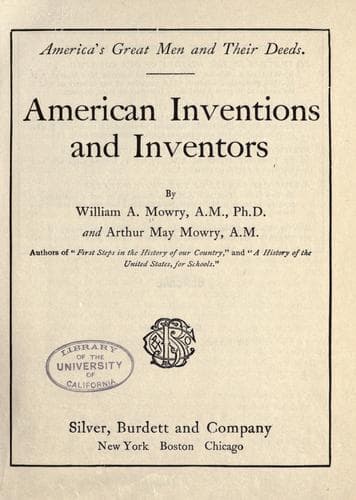
American Inventions and InventorsMowry, William A. (William Augustus)
History
American Inventions and Inventors
Mowry, William A. (William Augustus)
Inventions
Talking or conversation suggests at least two persons, the speaker and
the hearer, and involves the use of the vocal organs on the part of
the talker and the ear, the instrument of hearing, on the part of the
listener. This power of communicating thought, as has been said, is
universal with the human race.
In childhood one learns the language of his parents and of the people
where he lives. In this country, Great Britain, Canada, and Australia,
most of the people speak the English language; in France, the French
tongue; in Russia, the Russian; in Germany, the German; in Turkey,
the Arabic; and so on. This common speech forms a great bond of unity
between all people of the same race, and by means of it we communicate
our ideas one to another.
There is another language differing widely from the gift of speech,
yet quite as important for the welfare of the human race. Barbarous
and savage tribes are dependent upon speech alone, but in civilized
countries the people have acquired another art, that of writing, or of
using a written language. In speech arbitrary sounds represent ideas.
In writing arbitrary symbols or characters, called letters and words,
are used. They are observed by the eye and not by the ear. This written
language is as extended, as sharp, as definite, as full and complete,
as is the language of speech. Moreover, it has a great advantage over
speech. Words can be spoken only to a person immediately present, but
words can be written and conveyed to one who is absent. No matter how
far apart two persons are, each can communicate his ideas to the other
just as well as if they were near.
This written language has still greater usefulness. By means of it
wise men of all countries who have had great thoughts, thoughts of
value to the whole human race, have been enabled to put those thoughts
into a permanent form. Thus they have been preserved and handed down
from generation to generation, so that we inherit to-day the wealth of
all the ages. We can make ourselves familiar with the great thoughts
uttered by Jesus, by Socrates, Aristotle, Shakespeare, Milton, Burke,
Patrick Henry, Daniel Webster, Emerson, Longfellow, and countless
others, so that they become our own property. Moreover, when the eye
gathers up these grand truths from the printed page, they are not
absorbed, they still remain there. They may be used and transmitted
again and again in the same book and upon the same page, even to future
generations.
Public-domain text, read in full here on John Shaqi.
Reviews
Reviews
No reviews yet
Be the first to share your thoughts on this work.
Elsewhere in the archive
Join the Discussion
Join the discussion
Sign in to leave a comment or review.
Sign InorCreate an account