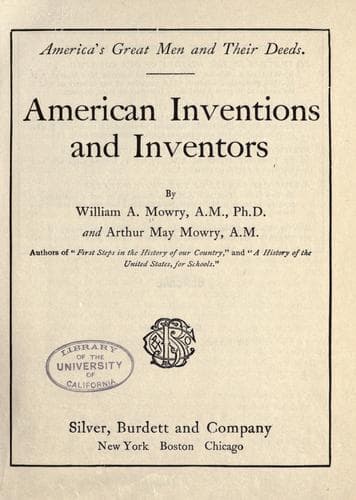
American Inventions and InventorsMowry, William A. (William Augustus)
History
American Inventions and Inventors
Mowry, William A. (William Augustus)
Inventions
Now see what the telegraph did. His death occurred about half-past nine
in the morning. As soon as possible the fact was telegraphed to our
minister in Paris. He forwarded the news to our minister in London; by
him it was cabled across the Atlantic, transmitted from the cable to
Washington and delivered to Nathaniel P. Banks, a member of the House
of Representatives from Massachusetts. General Banks read the dispatch
to the House, and delivered offhand an extended eulogy upon the
distinguished son of Massachusetts. That speech of General Banks was
written out, sent to the telegraph office, transmitted by the electric
current to the various cities of the country, put into type, printed in
the evening newspapers, and the writer of this chapter read it at four
o'clock in the afternoon of the same day that Mr. Burlingame died. This
was done as early as 1870.
But what is that compared to the greater wonders of the telephone?
That a man can "talk into" the little instrument, and his voice be
heard and recognized, and his words understood, by his friend in a
city five hundred or one thousand miles away, is indeed a miracle.
Consider for a moment what is done by means of the switchboard in the
central telephone office of a great city. Every one of the thousands
of subscribers has his own instrument for transmitting and receiving
messages. One of these subscribers rings a bell in his house or his
business office which rings another bell at the central station; the
attendant inquires "Hello! what number?" and receives a reply, "four,
naught, eight, Tremont." The attendant by a simple switch, turned by
a touch of the hand, makes the connection and rings the bell of that
subscriber whose number is "408 Tremont." Number "408 Tremont" steps
to the instrument and in a quiet voice says "Hello! who is it?" Thus
these two persons are placed in direct communication, and can talk with
each other, back and forth, as long as they please.
This conversation is carried on between two different sections of the
city where these two men live, but the same conversation may with equal
ease be carried on between Boston and New York, between Boston and
Washington, or between New York and Chicago. Thus time and distance are
annihilated and the whole world stands, as it were, face to face.
But the marvel does not end here. The above conversation is carried on
by means of a continuous wire which runs from one place to the other.
If there are parallel wires, strange to say, the vibrations carried on
in the one wire are liable to create, by induction, similar vibrations
in the parallel wire. Here is an illustration:
Public-domain text, read in full here on John Shaqi.
Reviews
Reviews
No reviews yet
Be the first to share your thoughts on this work.
Elsewhere in the archive
Join the Discussion
Join the discussion
Sign in to leave a comment or review.
Sign InorCreate an account