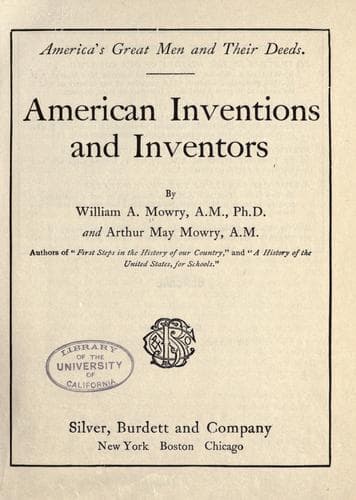
American Inventions and InventorsMowry, William A. (William Augustus)
History
American Inventions and Inventors
Mowry, William A. (William Augustus)
Inventions
Then the king said: "Bring me that priceless carpet and half my kingdom
shall be thine." The servant brought to the king a pair of shoes which
he had made in the night. This was a new carpet for the king; and so
this was the fourth good thing which the cow gave to Alice; the milk
she put down for the thumb, the butter for the first finger, the cheese
for the middle finger, and now she put leather for the third finger.
What great changes have taken place in the process of making boots and
shoes since this witty servant made the carpet for the king's feet!
Let us trace briefly the history of leather and the evolution of a pair
of shoes. In the early colonial days the skins of animals were widely
used for clothing. Caps were made for the men and boys from bear skins,
wolf skins, and the skins of the catamount. Overcoats with sleeves and
hoods were made of skins of wild animals properly dressed, with the
hair on. Moccasins for winter service were from the same material.
Buckskin breeches with fringed edges were in common use. These costumes
in the newly settled regions of our Western country continued until
fifty or sixty years ago.
[Illustration: DR. WHITMAN STARTING ON HIS JOURNEY.]
In the winter of 1842-43 Dr. Marcus Whitman made his memorable journey
from Oregon across the country to the States. On a later occasion he
described the dress which he wore on that remarkable horseback ride. He
said: "I wore buckskin breeches, fur moccasins, a blue duffle coat, a
buffalo overcoat with hood, and a bearskin cap. Rather a fantastic garb
for a missionary, wasn't it?"
Inventions and machinery have done much to improve the processes of
tanning leather. Tanning itself is a curious process. It changes raw
hides into a condition in which the skins are useful in the arts and
manufactures. This process renders the skins nearly impervious to
water, and makes them so tough that they can withstand the ravages of
time and remain firm and strong even for centuries.
It is said that specimens of leather have been discovered in China
which are surely three thousand years old. They had been tanned by
the process which is called "alum tannage." When Columbus discovered
America he found, in possession of the Indians, skins that had been
tanned. Their process of tanning, too, was practically the alum method.
Sir Edwin Arnold found a pair of slippers in a sarcophagus in India,
and nothing else was present except a small heap of dust. In the huts
of the Rock Dwellers in Arizona tanned leather has been found. In
ancient Babylon they had a process of tanning, and nearly two thousand
years ago the Russians and Hungarians were skilled in the art. The
ancient Romans knew how to tan leather with oil, alum, and bark.
Public-domain text, read in full here on John Shaqi.
Reviews
Reviews
No reviews yet
Be the first to share your thoughts on this work.
Elsewhere in the archive
Join the Discussion
Join the discussion
Sign in to leave a comment or review.
Sign InorCreate an account