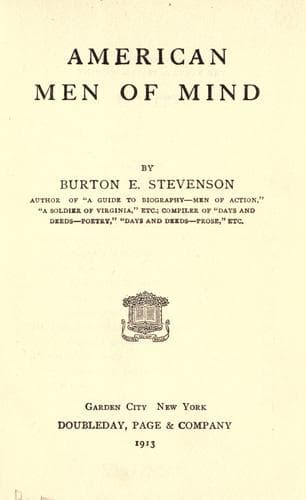
The last of the great American astronomers whom we shall mention here is
Edward Charles Pickering, whose name is so closely connected with the
development of the great observatory at Harvard. Born at Boston, and
educated at the Lawrence Scientific School, his first work was in the
field of physics, but in 1876, he was appointed professor of astronomy
and geodesy, and director of the Harvard observatory, which, under his
management, has become of the first importance. His principal work has
been the determination of the relative brightness of the stars, and many
thousands have been charted. On the death of Henry Draper, the study of
the spectra of the stars by means of photography was continued as a
memorial to that great scientist, and the results obtained have been of
the most important character, including a star map of the entire
heavens. Other phases of the science of scarcely less importance have
been carefully developed, and the work which has been done under
Pickering's direction, is second to none in the history of the science.
Not satisfied with the Northern hemisphere, a branch has been
established in Peru, in which the observatory's methods of research have
been extended to the south celestial pole. So for eighteen years and
more, it has kept ceaseless watch of the heavens, with an accuracy of
which the world has hardly a conception. For this great work the
scientific world must pay tribute to the genius and perseverance of
Edward Charles Pickering.
The second department of science claiming our attention is that of
paleontology. Here one of the most eminent of American names is that of
Othniel Charles Marsh. A graduate of Yale and firmly grounded in zoology
and kindred sciences by a course of study at Heidelberg and Berlin, he
returned to the United States in 1866 to accept the chair of
paleontology which had been established for him at Yale. The remainder
of his life was devoted to the original investigation of extinct
vertebrates, especially in the Rocky Mountain regions. In these
explorations, more than a thousand new species of extinct vertebrates
were brought to light, many of which possess great scientific interest,
representing new orders never before discovered in America. So important
was this work that the national geological survey undertook the
publication of his reports, which formed the most remarkable
contributions to the subject ever written in this country, attracting
the attention and admiration of the whole scientific world.
Public-domain text, read in full here on John Shaqi.
Reviews
Reviews
No reviews yet
Be the first to share your thoughts on this work.
Elsewhere in the archive
Join the Discussion
Join the discussion
Sign in to leave a comment or review.
Sign InorCreate an account