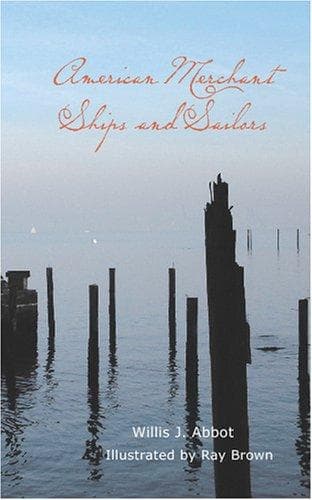
American Merchant Ships and SailorsAbbot, Willis J. (Willis John)
History
American Merchant Ships and Sailors
Abbot, Willis J. (Willis John)
Merchant marine -- United States -- History
In its earliest days, of course, privateering was the weapon of a nation
weak at sea against one with a large navy. So when the colonies threw down
the gage of battle to Great Britain, almost the first act of the
Revolutionary government was to authorize private owners to fit out armed
ships to prey on British commerce. Some of the shipowners of New England
had enjoyed some experience of the profits of this peculiar industry in
the Seven Years' War, when quite a number of colonial privateers harried
the French on the seas, and accordingly the response was prompt. In
enterprises of this character the system of profit-sharing, already noted
in connection with whaling, obtained. The owners took a certain share of
each prize, and the remainder was divided among the officers and crew in
certain fixed proportions. How great were the profits accruing to a
privateersman in a "run of luck" might be illustrated by two facts set
forth by Maclay, whose "History of American Privateers" is the chief
authority on the subject. He asserts that "it frequently happened that
even the common sailors received as their share in one cruise, over and
above their wages, one thousand dollars--a small fortune in those days for
a mariner," and further that "one of the boys in the 'Ranger,' who less
than a month before had left a farm, received as his share one ton of
sugar, from thirty to forty gallons of fourth-proof Jamaica rum, some
twenty pounds of cotton, and about the same quantity of ginger, logwood,
and allspice, besides seven hundred dollars in money." To be sure, in
order to enjoy gains like these, the men had to risk the perils of battle
in addition to the common ones of the sea; but it is a curious fact,
recognized in all branches of industry, that the mere peril of a calling
does not deter men from following it, and when it promises high profit it
is sure to be overcrowded. In civil life to-day the most dangerous
callings are those which are, as a rule, the most ill paid.
Very speedily the privateersmen became the most prosperous and the most
picturesque figures along the waterside of the Atlantic cities. While the
dignified merchant or shipowner, with a third interest in the "Daredevil"
or the "Flybynight," might still maintain the sober demeanor of a good
citizen and a pillar of the church, despite his profits of fifty or an
hundred per cent. on each cruise, the gallant sailors who came back to
town with pockets full of easily-won money, and the recollection of long
and dismal weeks at sea behind them, were spectacular in their rejoicings.
Their money was poured out freely while it lasted; and their example
stirred all the townsboys, from the best families down to the scourings of
the docks, to enter the same gentlemanlike profession.
Public-domain text, read in full here on John Shaqi.
Reviews
Reviews
No reviews yet
Be the first to share your thoughts on this work.
Elsewhere in the archive
Join the Discussion
Join the discussion
Sign in to leave a comment or review.
Sign InorCreate an account