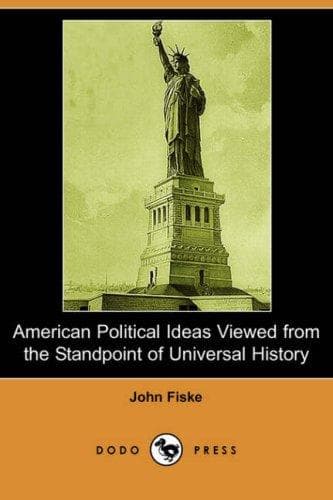
American Political Ideas Viewed from the Standpoint of Universal HistoryFiske, John
Philosophy
American Political Ideas Viewed from the Standpoint of Universal History
Fiske, John
United States -- History -- Philosophy; United States -- Politics and government
In the absence of such causes, and with the abundant
capacity of our country for feeding its people, I think it an extremely
moderate statement if we say that by the end of the next century the
English race in the United States will number at least six or seven
hundred millions.
It used to be said that so huge a people as this could not be kept
together as a single national aggregate,--or, if kept together at all,
could only be so by means of a powerful centralized government, like
that of ancient Rome under the emperors. I think we are now prepared to
see that this is a great mistake. If the Roman Empire could have
possessed that political vitality in all its parts which is secured to
the United States by the principles of equal representation and of
limited state sovereignty, it might well have defied all the shocks
which tribally-organized barbarism could ever have directed against it.
As it was, its strong centralized government did _not_ save it from
political disintegration. One of its weakest political features was
precisely this,--that its "strong centralized government" was a kind of
close corporation, governing a score of provinces in its own interest
rather than in the interest of the provincials. In contrast with such a
system as that of the Roman Empire, the skilfully elaborated American
system of federalism appears as one of the most important contributions
that the English race has made to the general work of civilization. The
working out of this feature in our national constitution, by Hamilton
and Madison and their associates, was the finest specimen of
constructive statesmanship that the world has ever seen. Not that these
statesmen originated the principle, but they gave form and expression to
the principle which was latent in the circumstances under which the
group of American colonies had grown up, and which suggested itself so
forcibly that the clear vision of these thinkers did not fail to seize
upon it as the fundamental principle upon which alone could the affairs
of a great people, spreading over a vast continent, be kept in a
condition approaching to something like permanent peace. Stated broadly,
so as to acquire somewhat the force of a universal proposition, the
principle of federalism is just this:--that the people of a state shall
have full and entire control of their own domestic affairs, which
directly concern them only, and which they will naturally manage with
more intelligence and with more zeal than any distant governing body
could possibly exercise; but that, as regards matters of common concern
between a group of states, a decision shall in every case be reached,
not by brutal warfare or by weary diplomacy, but by the systematic
legislation of a central government which represents both states and
people, and whose decisions can always be enforced, if necessary, by
the combined physical power of all the states. This principle, in
various practical applications, is so familiar to Americans to-day that
Public-domain text, read in full here on John Shaqi.
Reviews
Reviews
No reviews yet
Be the first to share your thoughts on this work.
Elsewhere in the archive
Join the Discussion
Join the discussion
Sign in to leave a comment or review.
Sign InorCreate an account