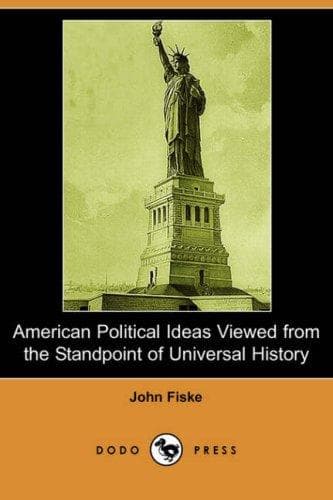
American Political Ideas Viewed from the Standpoint of Universal HistoryFiske, John
Philosophy
American Political Ideas Viewed from the Standpoint of Universal History
Fiske, John
United States -- History -- Philosophy; United States -- Politics and government
The object, therefore, for which the American government fought, was the
perpetual maintenance of that peculiar state of things which the federal
union had created,--a state of things in which, throughout the whole
vast territory over which the Union holds sway, questions between
states, like questions between individuals, must be settled by legal
argument and judicial decisions and not by wager of battle. Far better
to demonstrate this point once for all, at whatever cost, than to be
burdened hereafter, like the states of Europe, with frontier fortresses
and standing armies and all the barbaric apparatus of mutual suspicion!
For so great an end did this most pacific people engage in an obstinate
war, and never did any war so thoroughly illustrate how military power
may be wielded, when necessary, by a people that has passed entirely
from the military into the industrial stage of civilization. The events
falsified all the predictions that were drawn from the contemplation of
societies less advanced politically. It was thought that so peaceful a
people could not raise a great army on demand; yet within a twelvemonth
the government had raised five hundred thousand men by voluntary
enlistment. It was thought that a territory involving military
operations at points as far apart as Paris and Moscow could never be
thoroughly conquered; yet in April 1865 the federal armies might have
inarched from end to end of the Gulf States without meeting any force to
oppose them. It was thought that the maintenance of a great army would
beget a military temper in the Americans and lead to manifestations of
Bonapartism,--domestic usurpation and foreign aggression; yet the moment
the work was done the great army vanished, and a force of twenty-five
thousand men was found sufficient for the military needs of the whole
country. It was thought that eleven states which had struggled so hard
to escape from the federal tie could not be re-admitted to voluntary
co-operation in the general government, but must henceforth be held as
conquered territory,--a most dangerous experiment for any free people to
try. Yet within a dozen years we find the old federal relations resumed
in all their completeness, and the disunion party powerless and
discredited in the very states where once it had wrought such mischief.
Nay more, we even see a curiously disputed presidential election, in
which the votes of the southern states were given almost with unanimity
to one of the candidates, decided quietly by a court of arbitration; and
we see a universal acquiescence in the decision, even in spite of a
general belief that an extraordinary combination of legal subtleties
resulted in adjudging the presidency to the candidate who was not
really elected.
Public-domain text, read in full here on John Shaqi.
Reviews
Reviews
No reviews yet
Be the first to share your thoughts on this work.
Elsewhere in the archive
Join the Discussion
Join the discussion
Sign in to leave a comment or review.
Sign InorCreate an account